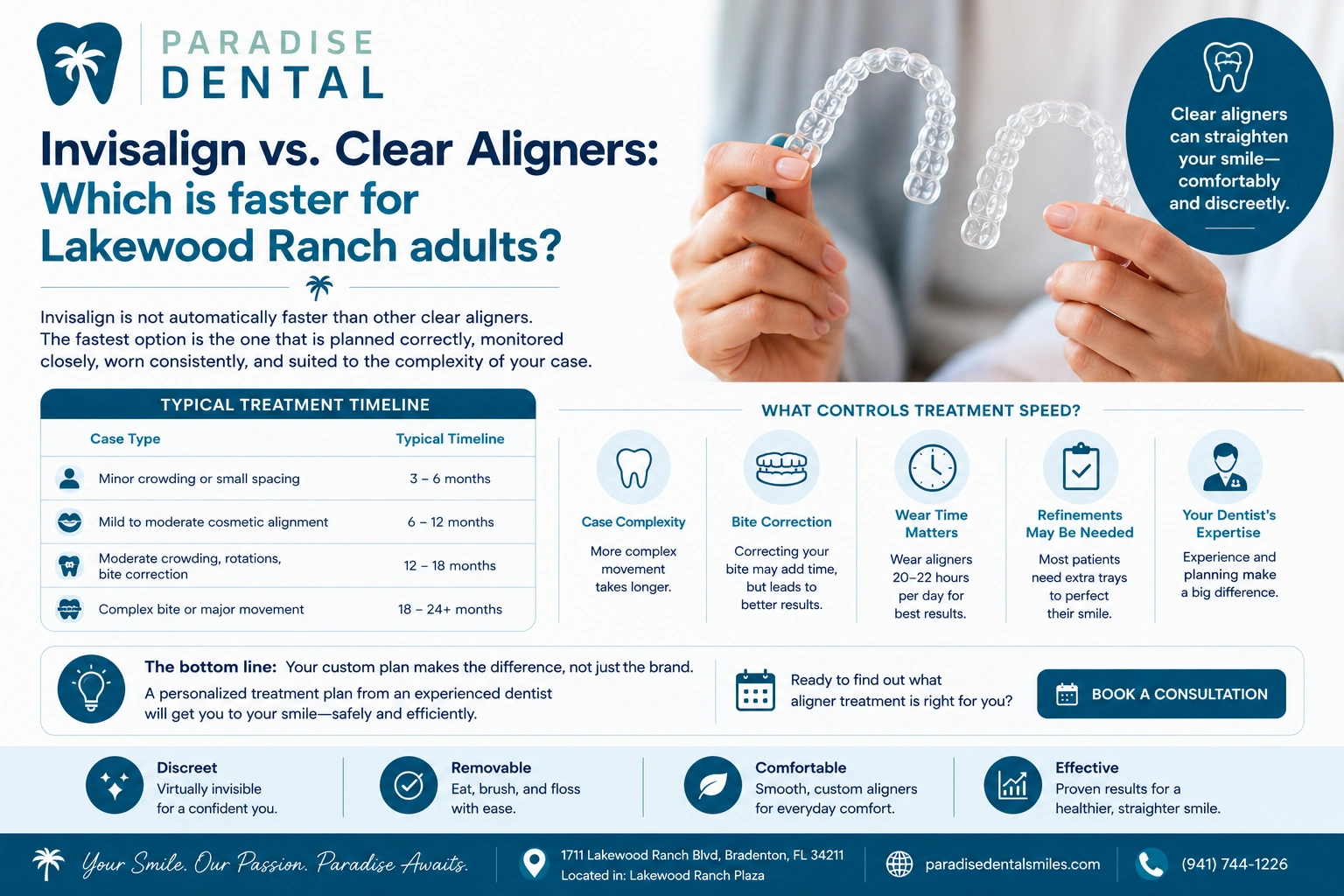
For most adults in Lakewood Ranch, Invisalign is not automatically faster than every other clear aligner system.
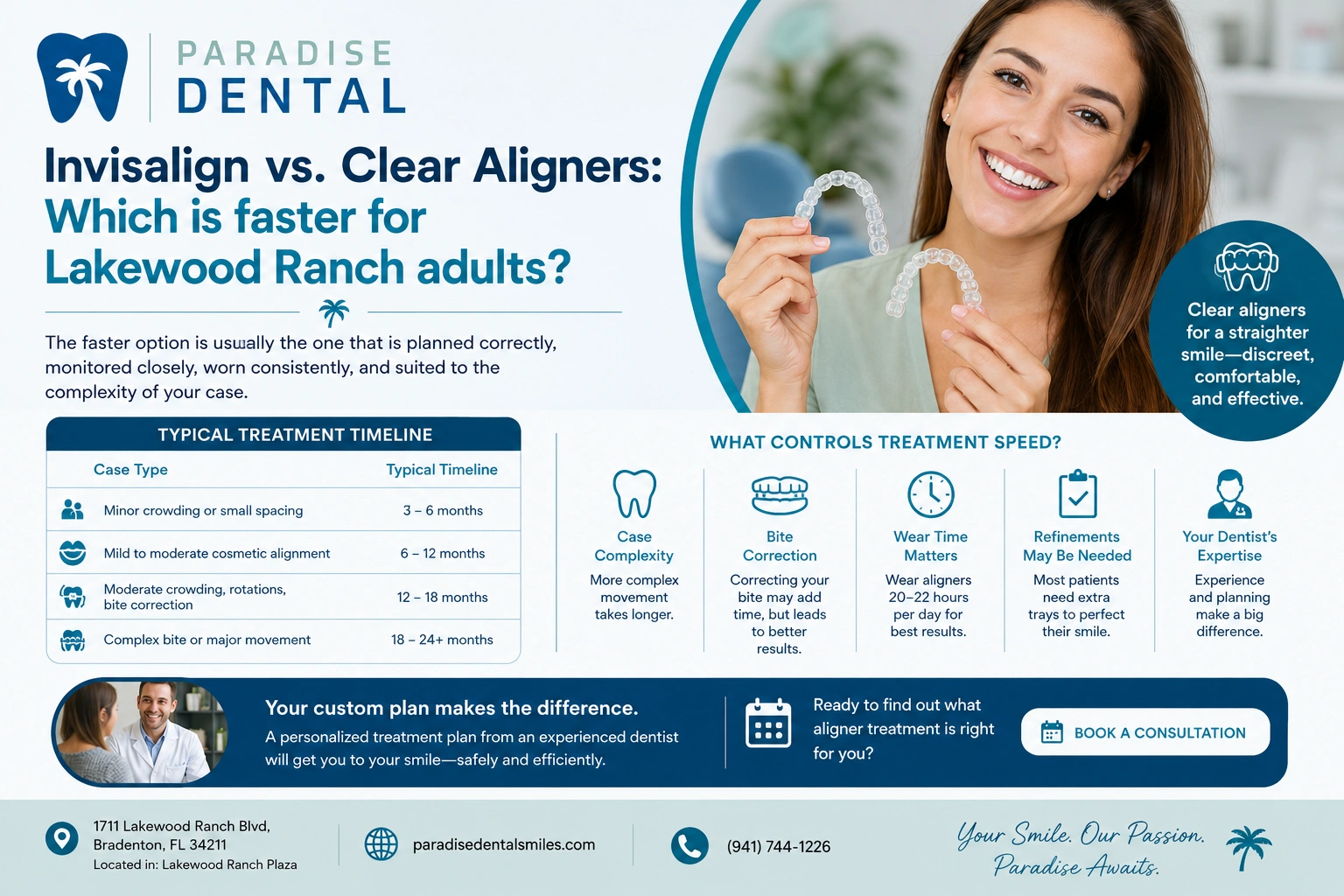
The faster option is usually the one that is planned correctly, monitored closely, worn consistently, and suited to the complexity of your case.
That said, Invisalign often has an advantage for adults with more than simple crowding or spacing because it is a mature, doctor-directed clear aligner system with tools for attachments, bite correction, refinements, and complex tooth movement. Invisalign says treatment may show changes within weeks and may be completed in as little as 6 months for some cases, but only a dentist or orthodontic provider can estimate your actual timeline.
For many adults, the realistic range is:
| Case type | Typical timeline |
| Minor crowding or small spacing | 3–6 months |
| Mild to moderate cosmetic alignment | 6–12 months |
| Moderate crowding, rotations, bite correction | 12–18 months |
| Complex bite or major movement | 18–24+ months |
The important part is this: the brand name matters less than the diagnosis.
First, what do people mean by “clear aligners”?
“Invisalign” is a brand of clear aligners.
“Clear aligners” is the broader category. That can include Invisalign, SureSmile, Spark, 3M Clarity, uLab, in-office aligner systems, and other doctor-directed options.
It can also include mail-order or mostly remote aligner companies, although those are a different conversation because adult tooth movement should be supervised carefully.
The American Association of Orthodontists describes clear aligner therapy as a treatment that uses removable transparent trays to gradually move teeth. Clear aligners are popular partly because they are less noticeable than traditional braces, especially for adults.
But “clear” does not mean simple.
Moving teeth still affects the gums, bone, bite, roots, jaw joints, and long-term stability.
The direct answer: which is faster?
For Lakewood Ranch adults, here is the practical answer:
If your case is very minor, several clear aligner systems may be equally fast.
If you only need small front-tooth alignment, slight spacing closure, or minor relapse after braces, the difference between Invisalign and another doctor-directed clear aligner may be small.
If your case involves bite correction, rotated teeth, crowding, missing teeth, worn teeth, gum recession, or previous dental work, Invisalign may be more predictable — but not always shorter.
Sometimes the better-planned treatment takes longer upfront but avoids delays, poor tracking, refinements, or relapse later.
That is the part patients often miss.
The fastest aligner plan on paper is not always the fastest path to a stable result.
What actually controls treatment speed?
Clear aligners do not move teeth faster just because the box says so.
Treatment speed depends on five things.
1. How complicated the tooth movement is
Small tipping movements are usually faster.
Bigger movements take longer, especially when the tooth root has to move through bone.
Movements that often add time include:
- rotating round teeth, especially canines
- correcting deep bites
- correcting open bites
- moving molars
- closing larger gaps
- expanding narrow arches
- fixing midline issues
- correcting crowding without creating gum problems
- working around crowns, bridges, implants, or missing teeth
This is where the recommendation changes.
A 32-year-old who had braces as a teen and only has mild shifting is not the same as a 58-year-old with crowding, worn edges, gum recession, and old crowns.
Both may want “clear aligners.” They do not need the same plan.
2. Whether your bite is being corrected or just your front teeth
Many adults think they only want straighter front teeth.
That can be reasonable.
But sometimes the visible crowding is caused by a bite problem.
For example:
- lower front teeth crowding may be connected to bite pressure
- worn edges may suggest grinding or tooth-on-tooth trauma
- flared teeth may be caused by spacing, tongue pressure, or gum/bone changes
- shifting after missing teeth can affect the bite
A fast cosmetic-only plan may make the front teeth look better but leave the bite unstable.
That does not mean every patient needs full orthodontic correction. It means the dentist should explain what is being treated and what is being left alone.
A good question to ask is:
“Are we only aligning the visible teeth, or are we also correcting the bite?”
3. How many hours per day you actually wear the aligners
This is the biggest speed factor patients control.
Invisalign says patients typically wear aligners 20 to 22 hours per day for best results.
That means the aligners are out only for:
- eating
- drinking anything besides water
- brushing
- flossing
- cleaning the trays
If you wear aligners 14 to 16 hours a day, treatment may still look like it is “working” at first. But teeth can stop tracking properly. The next tray may feel too tight, attachments may not engage correctly, and the dentist may need to rescan or order refinements.
That can turn a 7-month case into a 12-month case.
For busy Lakewood Ranch adults who travel, attend business lunches, play golf, or split time between Florida and another home, compliance is a real issue. Aligners are convenient, but they only work when they are in your mouth.
4. Whether refinements are needed
Most adults should expect that refinements may be part of the process.
A refinement means additional trays after the first planned series because some teeth need more movement or detailing.
This is not necessarily a failure. Teeth are biological. They do not always move exactly like the software simulation predicts.
Research on clear aligner treatment has noted that initial case complexity can be associated with the need for more aligners and refinements.
A clear aligner system that allows well-managed refinements can sometimes be slower than advertised but more predictable in the final result.
That is why “only 20 trays” or “done in 4 months” should be treated carefully unless the dentist has explained what happens if your teeth do not track as planned.
5. The provider’s experience
Clear aligner software does not replace diagnosis.
The software shows a planned movement. The dentist or orthodontic provider has to decide whether that movement is realistic, safe, stable, and appropriate for your mouth.
This matters especially for adults with:
- gum recession
- bone loss
- missing teeth
- implants
- crowns or veneers
- worn teeth
- TMJ symptoms
- grinding
- periodontal history
- cosmetic goals after aligners
An adult aligner plan should not be designed as if your teeth exist in a vacuum.
At Paradise Dental, Dr. Jeffrey Martins or a Paradise Dental clinician would evaluate not only whether your teeth can be moved, but whether moving them supports your long-term bite, gum health, and cosmetic goals.
Is Invisalign faster than mail-order aligners?
Often, yes for anything beyond very minor movement — but the better word is usually safer or more controlled, not just faster.
Mail-order aligners may advertise shorter treatment times because they often focus on limited cosmetic movement. That can sound appealing.
But there are tradeoffs.
Limited or remote treatment may not fully evaluate:
- gum disease
- bone levels
- cavities
- cracked teeth
- bite problems
- root position
- jaw joint symptoms
- failing crowns or fillings
- whether teeth can safely move in the desired direction
For a very minor relapse case in a healthy mouth, a limited aligner plan may be reasonable if properly evaluated. But for many adults, especially those who have not had recent dental X-rays or a gum evaluation, starting tooth movement without a complete exam is risky.
The faster-looking option may become slower if it creates bite problems, gum issues, or a result that needs correction later.
Is Invisalign faster than braces?
Sometimes.
But not always.
Clear aligners can be very efficient for certain movements, especially mild to moderate crowding or spacing. Braces may be faster or more predictable for more complex tooth movement, severe rotations, significant bite correction, impacted teeth, or cases requiring very precise root control.
For adults, the best comparison is not:
“Which is faster?”
It is:
“Which option can get my teeth and bite where they need to go with the fewest compromises?”
Some adults choose Invisalign because they value appearance, comfort, easier brushing and flossing, and fewer lifestyle interruptions.
Other adults may be better served with braces or a hybrid approach.
A good dentist should be willing to say when clear aligners are not the best fit.
Why adults in Lakewood Ranch often have different timelines than teens
Adult aligner treatment can be very successful, but adults bring different variables than teenagers.
Many adult patients have:
- older fillings
- crowns
- veneers
- dental implants
- gum recession
- bone loss
- missing teeth
- grinding or clenching
- worn enamel
- previous orthodontic relapse
- cosmetic expectations
- budget and time constraints
A teenager may simply need tooth movement.
An adult may need tooth movement that works around restorative dentistry, cosmetic goals, gum health, and bite protection.
That does not mean adults always take longer. But it does mean the planning has to be more thoughtful.
When Invisalign may be the faster choice
Invisalign may be faster or more predictable when:
- the case needs attachments for controlled movement
- bite correction is part of the plan
- rotations need more precise control
- refinements are likely
- the patient has crowns, veneers, or cosmetic concerns
- the dentist is planning aligners as part of a larger smile makeover
- the case needs careful staging before bonding, veneers, crowns, or implants
For example, if a Lakewood Ranch adult wants veneers but the teeth are crowded or unevenly positioned, aligners first may reduce how much tooth structure has to be removed for veneers.
That may not be the fastest cosmetic path, but it may be the more conservative one.
When another clear aligner system may be just as fast
Another doctor-directed clear aligner system may be just as fast when:
- the crowding is mild
- the bite is already stable
- gum health is good
- no major rotations are needed
- the goal is limited cosmetic alignment
- the provider has strong experience with that system
- the treatment plan is monitored in person
In these cases, the difference between Invisalign and another reputable aligner system may come down to provider preference, lab workflow, cost, software, material, and refinement policies.
The patient does not need the most recognizable brand every time.
They need the right plan.
What can make aligner treatment slower?
The most common delays are not mysterious.
They usually come from:
- not wearing trays enough
- losing trays
- skipping appointments
- teeth not tracking
- attachments coming off
- needing refinements
- untreated gum inflammation
- cavities during treatment
- bite problems becoming more obvious
- unrealistic treatment goals
- trying to move teeth too aggressively
The lowest-cost or shortest plan may be tempting, but it can backfire if it ignores biology.
Moving teeth too quickly or without proper monitoring can increase the risk of gum recession, unstable bite, poor fit, or relapse.
How to know which option is right for you
Before choosing Invisalign or another clear aligner system, ask these questions:
- How long do you expect my case to take?
- Is this a simple alignment case or a bite correction case?
- Will I need attachments?
- How many hours per day do I need to wear the trays?
- What happens if my teeth do not track?
- Are refinements included?
- Do I have gum or bone issues that affect treatment?
- Will aligners change my bite?
- Do I need dental work before starting?
- Will I need retainers afterward?
The retainer question matters. Teeth can shift after treatment if they are not retained. Clear aligner treatment is not truly finished until there is a plan to hold the result.
The Paradise Dental answer
For most Lakewood Ranch adults, Invisalign may be the more predictable choice for moderate or more involved cases, but it is not automatically faster for every patient.
A simple case may move quickly with several doctor-directed clear aligner systems.
A more complex adult case needs careful planning, healthy gums, realistic timelines, and a provider who can manage refinements and bite changes.
At Paradise Dental in Bradenton, the goal is not to push a brand. It is to answer the more important questions:
Can your teeth move safely?
What result are you expecting?
Is this cosmetic alignment or bite correction?
How long will it really take?
What are the tradeoffs?
If you are unsure which category your case falls into, the next step is a proper exam, digital imaging, and a clear explanation of your options before you commit to aligner treatment.