One of the most frustrating things for patients researching dental crowns is seeing completely different prices online.
One office quotes $1,100.
Another says $1,800.
Another is over $2,000.
So what is the actual difference?
In most cases, it is not just markup.
Dental crown pricing varies because the treatment itself varies. Two crowns may look similar on paper while involving very different materials, technology, lab work, tooth conditions, and long-term expectations.
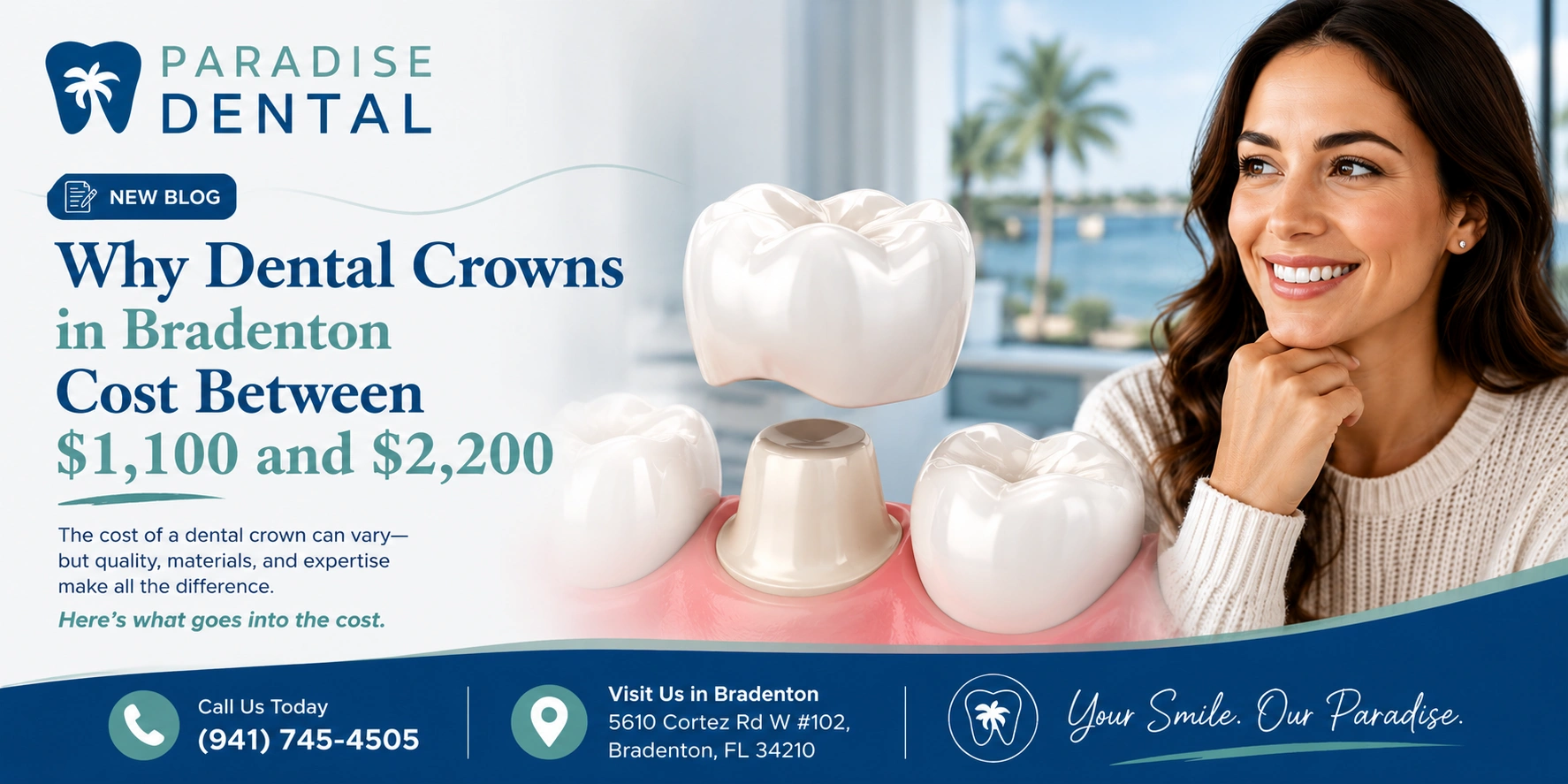
For most patients in Bradenton and Lakewood Ranch, the realistic cost of a dental crown falls somewhere between $1,100 and $2,200 per tooth.
The important question is what you are actually paying for and whether the cheaper option creates problems later.
What Is a Dental Crown?
A dental crown is a custom-made “cap” that covers a damaged tooth.
Crowns are commonly recommended when a tooth:
- has a large cavity
- is cracked or weakened
- broke after a root canal
- has severe wear
- cannot safely hold a filling anymore
- needs cosmetic improvement with added strength
The goal is usually both protection and function.
A properly designed crown should help the tooth handle chewing forces while also blending naturally with nearby teeth.
Why One Crown Costs Twice as Much as Another
This is where the recommendation and pricing changes.
Not all crowns are created the same.
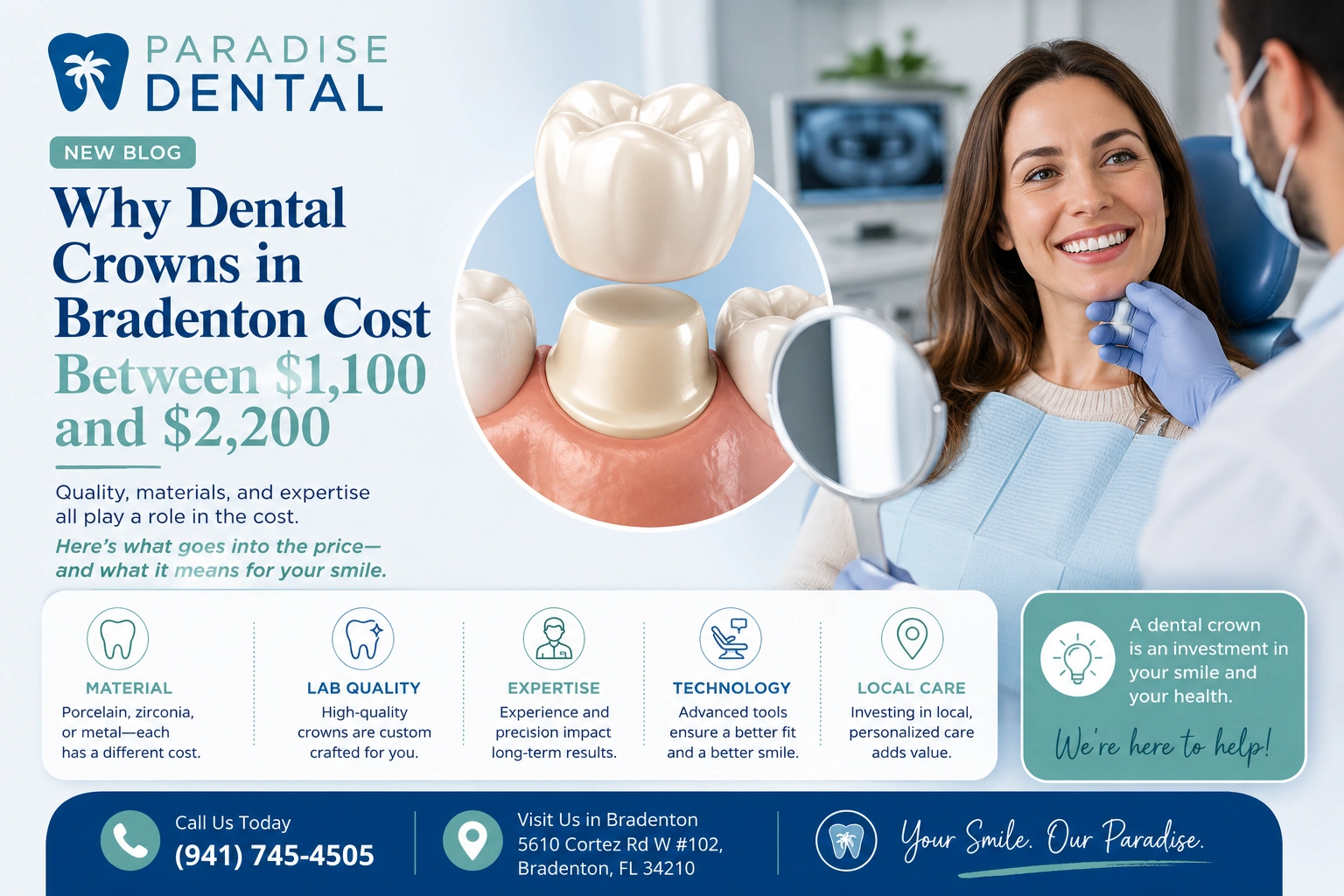
The biggest factors affecting cost are:
- Material quality
- Lab customization
- Tooth location
- Technology used
- Complexity of the tooth
- Gum condition
- Bite issues
- Whether additional procedures are needed
A crown on a healthy front tooth is very different from rebuilding a severely cracked molar with deep decay and bite problems.
Those are not interchangeable cases.
The Type of Crown Material Matters
Different materials have different costs, durability, and cosmetic outcomes.
Zirconia Crowns
Zirconia crowns are now one of the most common options because they are strong and highly durable.
They are often recommended for back teeth where chewing pressure is highest.
Higher-end zirconia can also look very natural, but the lab work matters significantly.
Porcelain or Ceramic Crowns
These are commonly used for highly visible front teeth because they can mimic natural enamel better in some situations.
More cosmetic customization usually increases cost.
Porcelain-Fused-to-Metal Crowns
These older crowns may cost less in some offices but are becoming less common aesthetically because metal edges can eventually show near the gums.
For some patients, they are still a practical option.
That does not automatically mean the most expensive material is necessary.
A good dentist should explain:
- strength tradeoffs
- cosmetic expectations
- longevity
- grinding risks
- and where premium materials truly matter
The Lab Makes a Bigger Difference Than Patients Realize
This is one of the least understood parts of crown pricing.
Some crowns are mass-produced through lower-cost labs. Others are highly customized by experienced dental ceramists.
That affects:
- shape
- color matching
- translucency
- bite fit
- comfort
- natural appearance
A poorly fitting crown can create:
- bite pain
- gum irritation
- food trapping
- fracture risk
- sensitivity
- or repeat treatment later
For cosmetic or highly visible teeth, lab quality becomes especially important.
This is one reason crown pricing varies so much between offices.
Same-Day Crowns vs. Custom Lab Crowns
Some practices offer same-day crowns using in-office milling technology.
These can be convenient and reduce the need for temporary crowns.
But convenience is not always the deciding factor.
In some cases, an outside cosmetic lab may provide:
- better esthetics
- more detailed layering
- stronger customization
- or improved long-term appearance
For straightforward cases, same-day crowns can work very well.
For more complex cosmetic cases, many dentists still prefer detailed lab fabrication.
Sometimes the Crown Is Not the Expensive Part
Patients are often surprised that additional treatment can significantly affect the total cost.
For example:
- Build-ups for heavily damaged teeth
- Root canals
- Replacing old fillings
- Gum treatment
- Bite adjustment
- Sedation
- Temporary crowns
- Cracked tooth stabilization
A tooth with deep decay near the nerve may require both a root canal and a crown.
That can dramatically change the final cost.
The important question is why the tooth failed in the first place.
If grinding, clenching, or bite instability caused the damage, ignoring those issues may shorten the life of the new crown.
Insurance Usually Does Not Cover Everything
This is another area patients misunderstand.
Many dental insurance plans contribute toward crowns, but coverage is often limited.
Typical insurance considerations include:
- annual maximums
- waiting periods
- downgraded materials
- frequency limitations
- cosmetic exclusions
Some plans only reimburse based on a lower-cost material even if a stronger or more aesthetic material is recommended.
That does not mean the recommendation is unnecessary.
But patients deserve a clear explanation of:
- what insurance covers
- what it does not
- and why certain materials are being recommended
The Cheapest Crown Is Not Always the Lowest-Cost Option
This is where many patients get stuck.
A lower upfront price can absolutely make sense in some situations.
But extremely low-cost crowns sometimes involve compromises:
- rushed prep work
- lower-quality labs
- poor bite adjustment
- weaker materials
- minimal cosmetic customization
When crowns fail early, patients may face:
- replacement costs
- root canals
- fractures
- gum issues
- or tooth loss
That does not mean every expensive crown is automatically better.
But a good dentist should be able to explain exactly why the crown costs what it does.
When a Crown May Not Be Necessary
This is important.
Not every damaged tooth automatically needs a crown.
Sometimes:
- a filling is still reasonable
- bonding may work
- monitoring is appropriate
- or the tooth may already be too compromised for long-term crown success
At Paradise Dental in Bradenton, Dr. Jeffrey Martins evaluates:
- remaining tooth structure
- crack patterns
- bite pressure
- gum health
- decay depth
- long-term predictability
- and whether more conservative treatment is still realistic
Sometimes patients are surprised to hear a crown is unnecessary.
Other times, delaying treatment creates a much larger problem later.
So Why Do Crowns Vary From $1,100 to $2,200?
Because the treatment itself varies.
The difference often comes down to:
- material quality
- lab craftsmanship
- complexity
- durability
- cosmetic detail
- and how much work is required to make the tooth predictable long-term
For most patients, the goal should not be finding the cheapest crown possible.
It should be understanding:
- what condition the tooth is in
- what options are realistic
- what affects longevity
- and which treatment makes sense for your mouth, budget, and goals
At Paradise Dental, the focus is not on pushing the most expensive option. It is helping patients understand the tradeoffs clearly so they can make informed decisions about their dental health long-term.