2026 Price Guide for One Missing Tooth
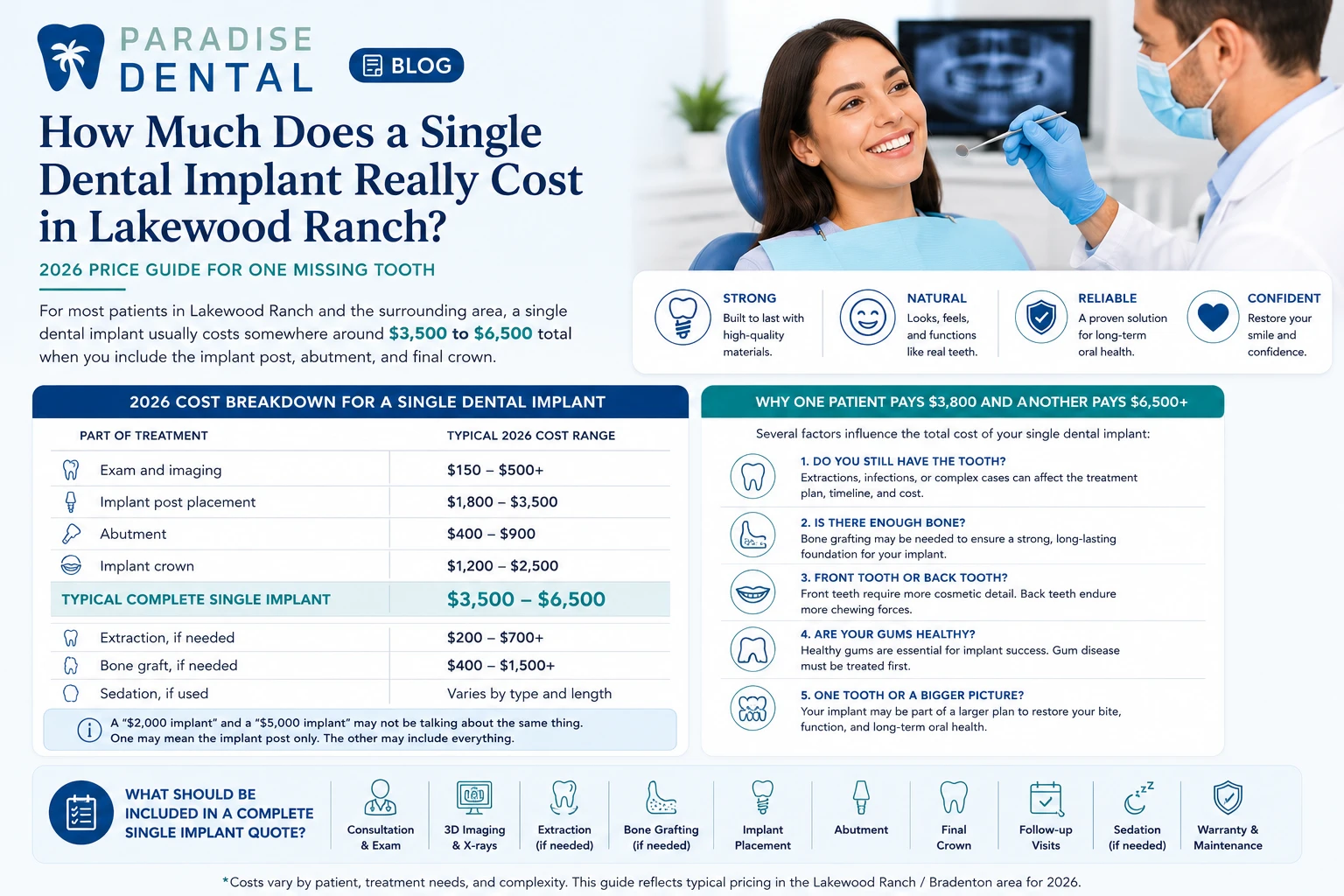
For most patients in Lakewood Ranch, Bradenton, and the surrounding Manatee County area, a single dental implant usually costs somewhere around $3,500 to $6,500 total when you include the implant post, abutment, and final crown.
That is the realistic range for a complete tooth replacement — not just the implant screw.
A very simple case may land closer to the lower end. A more involved case with extraction, bone grafting, sinus issues, gum disease, sedation, or a highly aesthetic front-tooth crown can cost more. National and Florida-specific 2026 implant cost guides commonly place a complete single implant in the $3,000 to $6,000+ range, depending on what is included.
At Paradise Dental, the honest answer is this: you should not trust an implant quote until you know exactly what is included. A low advertised implant price may only cover the surgical implant post — not the crown, abutment, imaging, extraction, grafting, or follow-up care.
This article follows the same consumer-first, cost-transparency approach outlined in the Paradise Dental content strategy: answer the hard questions clearly before asking a patient to schedule.
The fast answer: what does one dental implant cost?
A single dental implant has three main parts:
- The implant post — the small titanium or ceramic post placed in the jawbone
- The abutment — the connector between the implant and crown
- The crown — the visible tooth-shaped restoration
The American Dental Association describes implants as posts placed in the jaw that act as sturdy anchors for replacement teeth. Mayo Clinic similarly explains that the crown attaches to an extension of the implant called an abutment.
Here is the practical 2026 breakdown for a single tooth in the Lakewood Ranch / Bradenton area:
| Part of treatment | Typical 2026 cost range |
| Exam and imaging | $150–$500+ |
| Implant post placement | $1,800–$3,500 |
| Abutment | $400–$900 |
| Implant crown | $1,200–$2,500 |
| Typical complete single implant | $3,500–$6,500 |
| Extraction, if needed | $200–$700+ |
| Bone graft, if needed | $400–$1,500+ |
| Sedation, if used | Varies by type and length |
The important point: a “$2,000 implant” and a “$5,000 implant” may not be talking about the same thing.
One may mean the implant post only. The other may include the post, abutment, crown, planning, imaging, and follow-up visits.
Why one patient pays $3,800 and another pays $6,500+
This is where the recommendation changes.
Two patients can both be missing one tooth and still need very different treatment. A good dentist should be able to explain why.
1. Do you still have the tooth, or is it already missing?
If the tooth is still present and cannot be saved, it may need to be extracted first.
Sometimes the implant can be planned around the extraction. Other times, the site needs to heal first. If there is infection, bone loss, or a cracked root, the timeline and cost can change.
2. Is there enough bone?
An implant needs healthy bone for support. If the tooth has been missing for a while, the jawbone may have shrunk in that area.
That does not automatically mean you cannot get an implant. It may mean you need bone grafting first.
Bone grafting adds cost, but skipping it when it is needed can create bigger problems later: poor implant positioning, less stability, gum recession, or an implant crown that does not look natural.
3. Is it a front tooth or back tooth?
Front teeth are often more cosmetically demanding.
A front implant has to blend with your smile, gumline, tooth color, translucency, and neighboring teeth. In a visible smile zone, the crown design and gum architecture matter a lot.
Back teeth may be less visible, but they handle stronger chewing forces. That can affect implant size, crown material, bite design, and planning.
4. Are your gums healthy?
Implants are not immune to gum problems.
If you have active gum disease, bleeding gums, or poor bone support, placing an implant before stabilizing the mouth can be risky. The implant may still be possible, but the dentist should address the foundation first.
5. Are you replacing one tooth or solving a larger bite problem?
Sometimes a missing tooth is simple.
Other times, it is a sign of a bigger issue: grinding, bite collapse, failing old dental work, gum disease, or multiple teeth shifting.
That does not mean you need the most expensive treatment. It means the dentist should explain whether the implant is an isolated fix or part of a larger restorative plan.
What should be included in a complete single implant quote?
Before you compare prices between dental offices, ask what the quote includes.
A complete quote should be clear about:
- consultation and exam
- digital X-rays or 3D imaging
- extraction, if needed
- bone grafting, if needed
- implant placement
- healing cap or temporary option
- abutment
- final crown
- follow-up visits
- sedation, if requested or recommended
- warranty or maintenance expectations
- what happens if the implant site needs additional treatment
If an office gives you a very low implant price, ask this exact question:
“Is that the total cost for the implant, abutment, and final crown, or only the surgical implant post?”
That one question prevents a lot of confusion.
Does dental insurance cover implants?
Sometimes, but not always.
Many dental insurance plans still treat implants differently from basic dental care. Some plans may cover part of the crown, extraction, or grafting. Others may cover a portion of the implant itself. Some exclude implants completely.
This is why two patients with the same missing tooth can have very different out-of-pocket costs.
For most patients, insurance does not make the implant “free.” It may reduce part of the total cost, depending on:
- annual maximums
- missing tooth clauses
- waiting periods
- whether the plan considers implants covered
- whether the crown is covered separately
- whether bone grafting or extractions are included
A good dental office should help you understand the estimate, but the final decision usually comes from the insurance plan.
Is a dental implant always the best option?
No.
Dental implants are often an excellent long-term option, but they are not automatically the right answer for every patient.
For one missing tooth, the main alternatives are usually:
Option 1: Dental implant
Best for patients who want a fixed tooth replacement that does not rely on neighboring teeth.
The advantage is that an implant replaces the missing tooth root and supports a crown independently. The ADA describes implants as stable anchors for replacement teeth.
The downside is cost, surgery, healing time, and the need for enough bone and healthy gums.
Option 2: Dental bridge
A bridge can replace one missing tooth by using the neighboring teeth as supports.
This may be a reasonable option if the teeth on both sides already need crowns. It may be less ideal if those teeth are healthy, because placing a bridge usually means reshaping them.
Option 3: Removable partial denture
This is often the lowest-cost option.
It can be reasonable for someone who needs a temporary solution, is not ready for implant treatment, or has several missing teeth and needs a budget-conscious plan.
The tradeoff is that it is removable, can feel bulkier, may not chew as naturally, and does not preserve bone the same way an implant does.
Option 4: Do nothing for now
Sometimes waiting briefly is reasonable.
But leaving a space long-term can allow neighboring teeth to shift, opposing teeth to drift, bite pressure to change, and bone to shrink in the missing tooth area.
The important question is not just, “Can I wait?”
It is, “What happens if I wait six months, one year, or five years?”
How long does a single dental implant take?
Most single implants take several months from start to finish.
A simple timeline may look like this:
| Step | Typical timing |
| Exam, imaging, planning | First visit |
| Extraction or grafting, if needed | Same day or separate visit |
| Implant placement | Surgical visit |
| Healing period | Often 3–6 months |
| Abutment and final crown | After integration |
The FDA notes that healing after implant placement may take several months or longer before the final tooth is completed.
Some patients qualify for faster treatment. Others need more time because of infection, bone grafting, smoking history, medical conditions, or bite concerns.
A faster timeline is not always better. The goal is not just to get a tooth in quickly. The goal is to place the implant in a way that can handle chewing, look natural, and stay healthy.
Does getting a dental implant hurt?
Most patients are surprised that implant placement is usually more manageable than they expected.
During the procedure, the area is numbed. Some patients choose sedation depending on anxiety level, complexity, and the amount of treatment being done.
Afterward, soreness, swelling, and tenderness are normal for a few days. Many patients compare it to an extraction recovery, though every case is different.
The more involved cases — extractions, grafting, multiple implants, sinus lifts — usually come with more recovery than a straightforward single implant.
Why are implants in Lakewood Ranch sometimes priced higher than “discount implant” ads?
Lakewood Ranch and Bradenton have a wide range of dental pricing. You may see ads that make implants look much cheaper than the ranges above.
Some are legitimate limited-scope offers. Others are incomplete prices.
Common reasons a low advertised price may not reflect your true total:
- the crown is not included
- the abutment is not included
- imaging is separate
- extraction is separate
- bone grafting is separate
- sedation is separate
- the advertised price applies only to ideal cases
- the final crown material may be basic or temporary
- follow-up care may be limited
That does not mean the lowest-cost option is always bad.
For some patients, a lower-cost implant provider may be reasonable, especially if the case is simple and the office is clear about materials, planning, and follow-up care.
But if the quote is vague, rushed, or only focused on price, be careful. Implant dentistry depends on planning, bone, bite, gum health, surgical position, and the final restoration. The crown is not an afterthought. It is the tooth you actually live with.
What would Dr. Martins evaluate before giving you a real implant price?
At Paradise Dental, Dr. Jeffrey Martins or a Paradise Dental clinician would need to evaluate more than just the missing tooth.
A proper implant consultation should look at:
- the missing tooth location
- whether the tooth is already gone or still needs removal
- bone height and width
- gum health
- bite pressure and grinding
- neighboring teeth
- smile line and cosmetic expectations
- medical history
- smoking or vaping habits
- current infection or inflammation
- whether a bridge, partial, or implant is the better fit
- what your insurance may or may not help with
That is why an exact price without an exam is usually not honest.
A dentist can give a realistic range, but the final number depends on what is happening under the gums and in the bone.
When is a single implant worth the cost?
A single dental implant is often worth considering when:
- you are missing one tooth and want a fixed replacement
- the neighboring teeth are healthy and you do not want to cut them down for a bridge
- you have enough bone or are willing to graft if needed
- you want strong chewing function
- you want a long-term solution rather than a removable appliance
- the missing tooth is affecting your smile, speech, or confidence
It may not be the right first choice if:
- active gum disease is untreated
- bone loss is severe and you do not want grafting
- the space is temporary or part of a larger unresolved problem
- your budget requires a lower-cost short-term option
- medical factors make surgery higher risk
- expectations are unrealistic
A good dentist should be willing to say that.
The bottom line on single implant cost in Lakewood Ranch
For 2026, a realistic complete cost for one dental implant in the Lakewood Ranch / Bradenton area is usually:
$3,500 to $6,500 for the implant, abutment, and final crown.
It may be less in a very straightforward case or more if you need extraction, grafting, sedation, or advanced cosmetic planning.
The most important thing is not finding the cheapest implant. It is understanding what your quote includes, why your case costs what it does, and whether an implant is truly the best option for your mouth.
At Paradise Dental, the goal is not to push the most expensive treatment. It is to understand what is happening, explain your options clearly, and help you choose what makes sense for your health, timeline, and budget.