If you’ve ever stared at a dentist’s phone number for weeks before calling, you’re not alone.
If you’ve canceled appointments at the last minute, ignored a tooth that’s been bothering you for months, or told yourself you’ll schedule something “after the holidays” for the third year in a row, you’re not alone either.
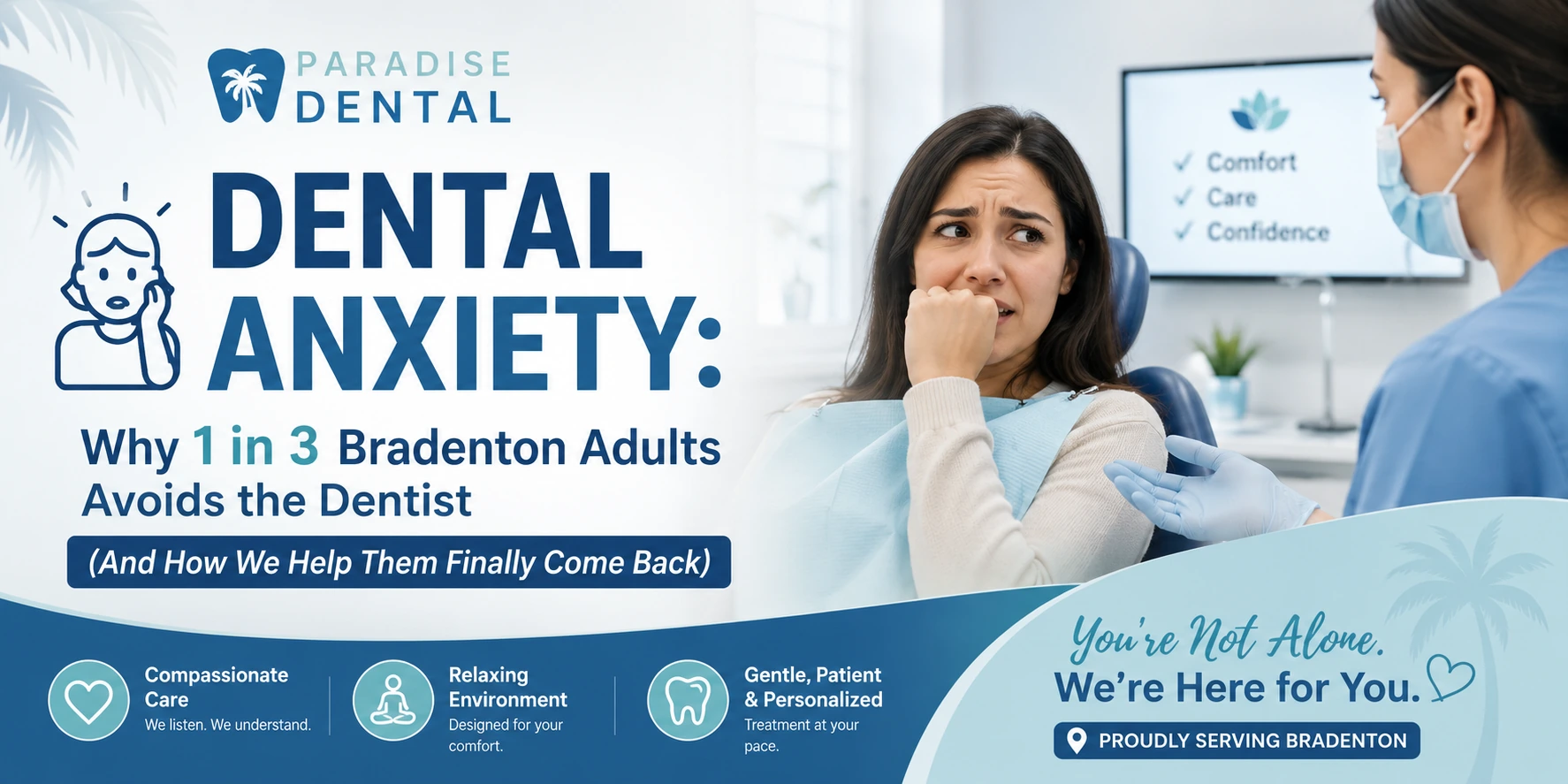
Dental anxiety affects millions of adults, including many right here in Bradenton and Lakewood Ranch.
And despite what people think, dental anxiety is rarely about being afraid of cleaning.
It’s usually about something deeper.
The Short Answer
Many adults avoid the dentist because they’re worried about one of four things:
- Pain
- Cost
- Judgment
- Bad news
The irony is that avoiding the dentist often makes all four worse.
The good news is that modern dentistry and the way good dental practices communicate with patients has changed dramatically.
For many anxious patients, the hardest part of the process is simply scheduling the first appointment.
What Dental Anxiety Actually Looks Like
Most people imagine dental anxiety means someone who is terrified of sitting in a dental chair.
Sometimes that’s true.
More often, it looks like:
- Putting off a cleaning for “a few more months”
- Ignoring sensitivity because it isn’t constant
- Waiting until a tooth hurts before calling
- Feeling embarrassed about how long it’s been
- Worrying about being lectured
- Assuming treatment will cost more than you can afford
In other words, it often looks like procrastination.
But the real issue underneath is fear.
The Four Reasons Adults Avoid the Dentist
1. Fear of Pain
This is still the biggest concern for many patients.
The problem is that most people’s expectations are based on stories from years or decades ago.
Modern dentistry has come a long way.
Yet many patients still picture the dental office they visited as a child.
A lot has changed since then.
2. Fear of Cost
This is the anxiety many dental websites never talk about.
Patients aren’t always afraid of treatment.
Sometimes they’re afraid of finding out they need treatment.
They worry they’ll hear:
- You need a crown.
- You need a root canal.
- You need implants.
- Your insurance won’t cover it.
That uncertainty alone keeps many people away.
3. Fear of Judgment
This one is surprisingly common.
Patients often tell us:
“I know I should have come in sooner.”
Or:
“You’re probably going to be upset when you see my teeth.”
The reality?
Dentists spend their days helping people solve problems.
They’re not keeping score.
A good dentist is far more interested in what happens next than what happened five years ago.
4. Fear of Bad News
Sometimes patients already suspect something is wrong.
They just don’t want confirmation.
The problem is that dental issues don’t usually improve by avoiding them.
A cavity doesn’t get smaller.
A cracked tooth doesn’t heal itself.
Gum disease doesn’t typically reverse without treatment.
Avoiding information may reduce anxiety temporarily, but it rarely improves the outcome.
Why Waiting Often Costs More
This is where dental anxiety becomes expensive.
A small cavity might require a filling.
A cavity that reaches the nerve may require:
- A root canal
- A crown
- Multiple appointments
- Significantly higher costs
The same pattern happens with:
- Gum disease
- Broken teeth
- Missing teeth
- Infections
The important question is not whether treatment is needed today.
It’s whether delaying treatment changes the outcome tomorrow.
The Most Common Thing We Hear From Nervous Patients
After treatment is finished, many patients say some version of:
“I wish I had done this sooner.”
Not because treatment was enjoyable.
Because it wasn’t nearly as bad as they imagined.
Most anxious patients spend months or years carrying the stress.
The appointment itself is usually the easy part.
How Paradise Dental Approaches Dental Anxiety
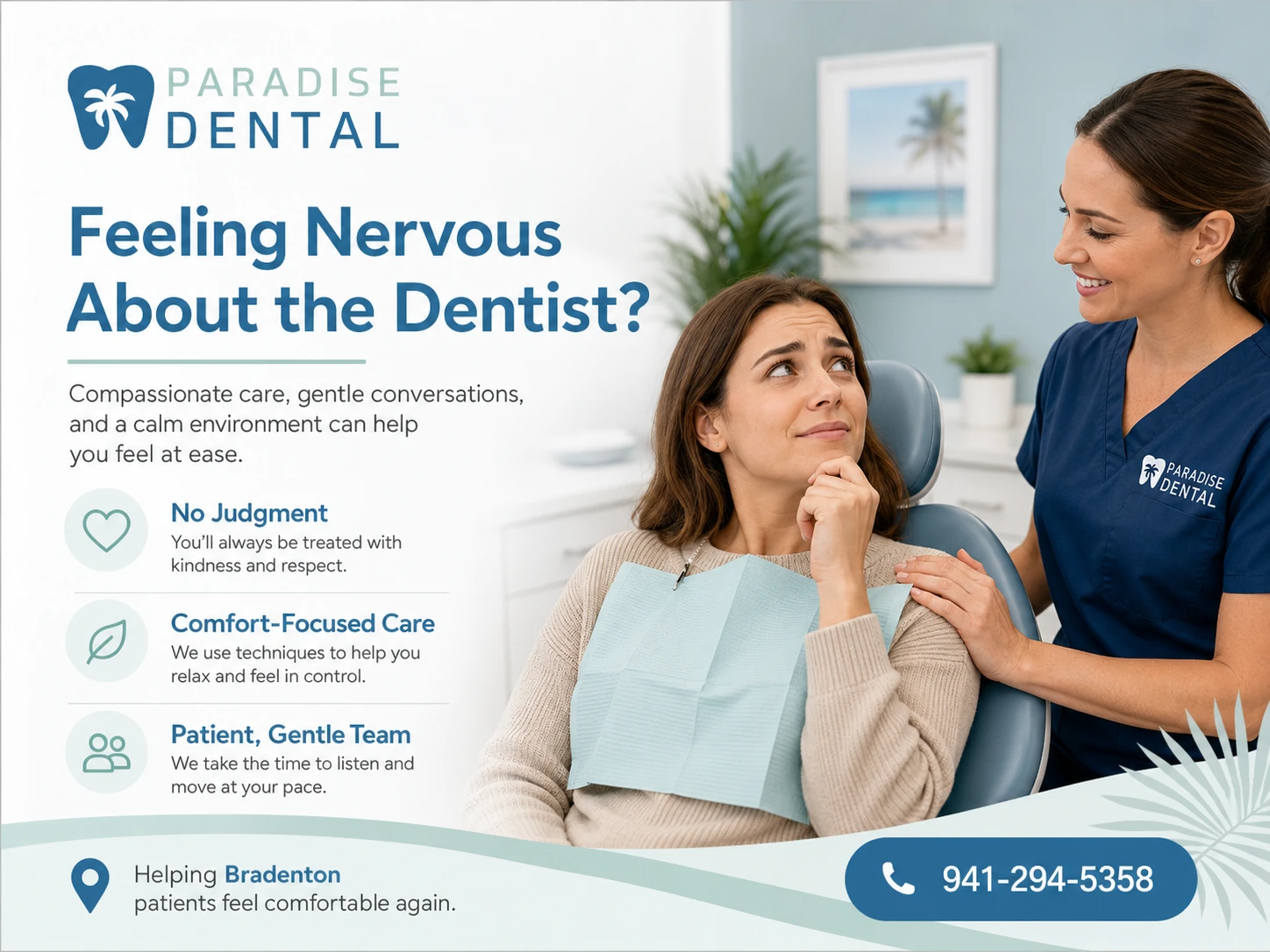
Here’s what many anxious patients need to hear:
We don’t start with treatment.
We start with understanding why you’re anxious.
Because the solution depends on the reason.
If You’re Worried About Pain
We’ll explain:
- What treatment involves
- What modern anesthetics can do
- What discomfort is realistic
- What recovery looks like
Fear tends to decrease when uncertainty decreases.
If You’re Worried About Cost
We’ll explain:
- What treatment is recommended
- What alternatives exist
- What can wait
- What insurance may cover
- What financing options may be available
Many patients feel better once they understand the numbers.
If You’re Embarrassed
You’re not the first patient who’s been away for years.
You won’t be the last.
The goal isn’t to make you feel guilty.
The goal is to help you move forward.
What About Sedation?
Some patients don’t need it.
Others benefit greatly from it.
Depending on the procedure and patient needs, comfort options may include:
- Nitrous oxide (laughing gas)
- Local anesthetic
- Additional comfort measures
A good dentist should explain the pros, cons, and appropriateness of each option.
That doesn’t automatically mean sedation is necessary.
But it’s important to know the option exists.
What If It’s Been 10 Years?
Or 15.
Or 20.
You’re probably imagining the worst.
Most patients are.
The reality is that many people who have been away from the dentist for years are surprised by what they learn.
Sometimes treatment is less extensive than expected.
Sometimes there are problems that need attention.
Either way, you finally have clarity.
And clarity is usually less stressful than uncertainty.
The First Visit Doesn’t Have to Be a Commitment
One of the biggest misconceptions about dental care is that walking into a dental office means agreeing to treatment.
It doesn’t.
Sometimes the first appointment is simply:
- An exam
- X-rays
- A conversation
- A treatment discussion
That’s it.
No pressure.
No obligation.
Just answers.
The Real Goal Isn’t Perfect Teeth
For most anxious patients, the first goal isn’t a perfect smile.
It’s breaking the cycle of avoidance.
Once that happens, everything else becomes easier.
At Paradise Dental, Dr. Jeffrey Martins understands that dental anxiety is often about much more than dentistry. It’s about trust, uncertainty, and feeling comfortable enough to ask questions. The goal is not to tell patients they shouldn’t be nervous. It’s to create an experience where they feel informed, respected, and confident enough to take the next step whatever that step may be.