Many adults in Bradenton and Sarasota still have silver fillings from childhood or early adulthood.
Some of those fillings have lasted 20 or 30 years.
That sounds impressive and in some ways, it is.
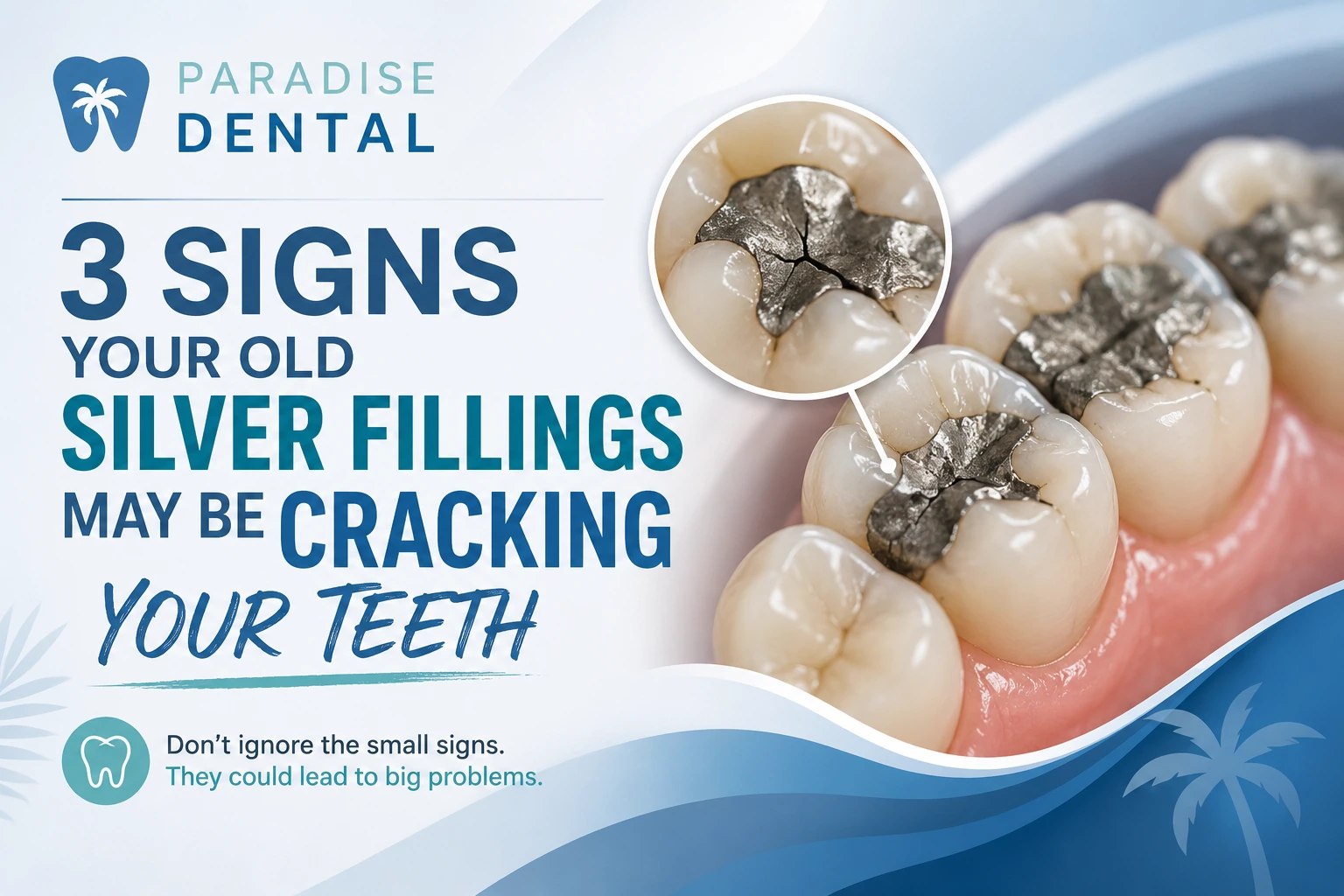
But what many patients do not realize is that large old amalgam (“silver”) fillings can sometimes weaken the surrounding tooth structure over time.
In fact, dentists often see teeth crack around old fillings rather than the filling itself failing first.
The important question is not whether silver fillings are automatically bad.
It is whether the tooth around the filling is still strong and stable.
First: Silver Fillings Are Not Automatically Dangerous
This topic gets sensationalized online.
Most existing amalgam fillings are not dental emergencies.
Many continue functioning well for years.
A good dentist does not usually recommend replacing silver fillings simply because they are silver.
The recommendation changes when:
- the filling is failing,
- decay develops underneath,
- the tooth is cracking,
- or the remaining tooth structure becomes weak.
That distinction matters.
Why Old Amalgam Fillings Can Stress Teeth
Silver fillings behave differently than modern bonded fillings.
Amalgam does not chemically bond to the tooth.
Instead, the tooth is mechanically shaped to hold the filling in place.
Over decades, large fillings combined with chewing pressure can contribute to:
- expansion and contraction,
- stress on tooth walls,
- weakened cusps,
- and fracture risk.
This is especially common in molars with large fillings that have been absorbing biting pressure for years.
Patients often think:
“The filling is fine.”
But the surrounding tooth may be slowly cracking.
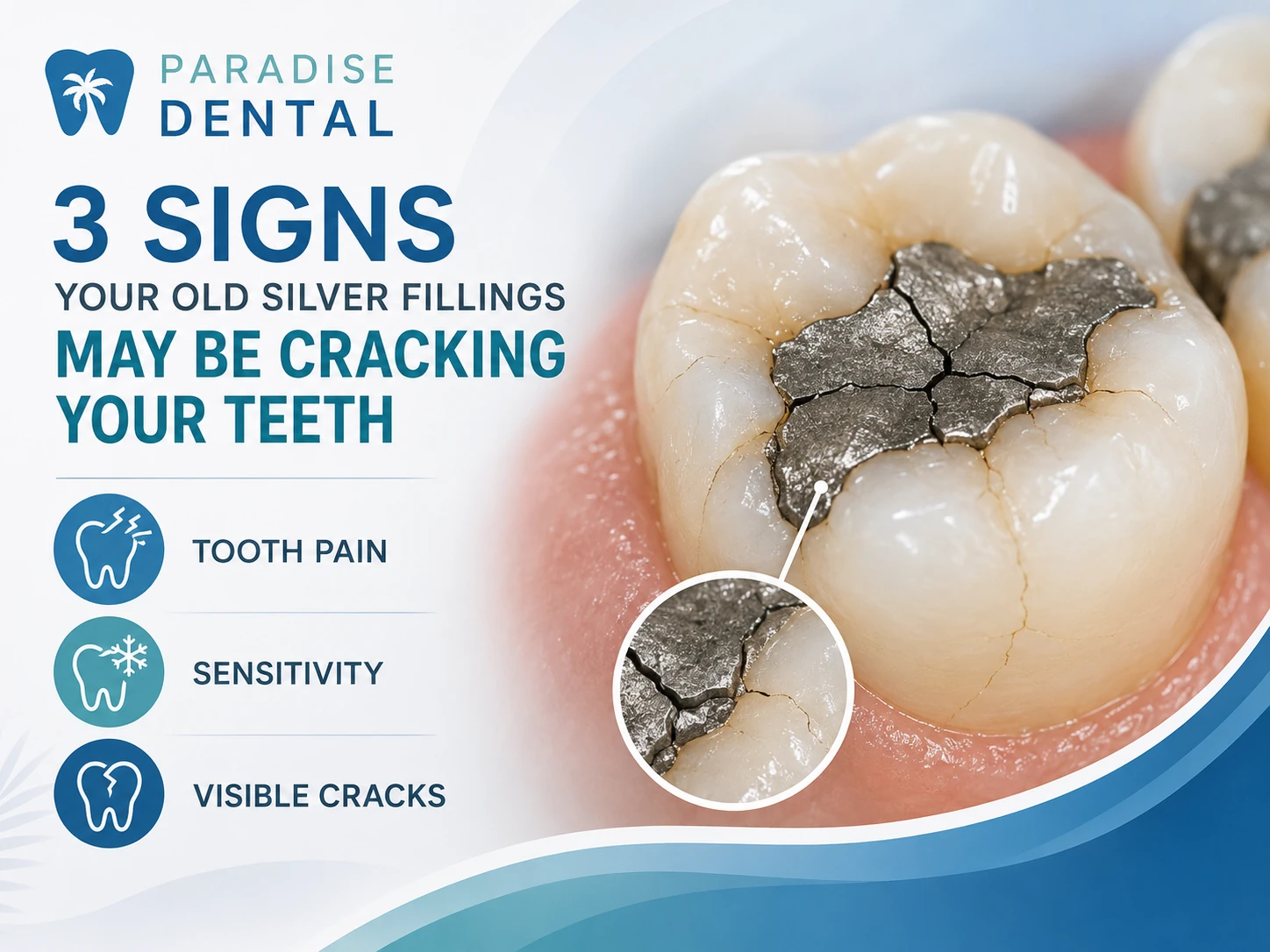
1. Sharp Pain When Chewing or Releasing Pressure
One of the classic warning signs of a cracked tooth is pain during chewing.
Especially:
- biting on hard foods,
- chewing ice,
- eating nuts,
- or releasing pressure after biting down.
Patients often describe it as:
- a quick “zing”
- sharp pressure pain
- or discomfort that comes and goes unpredictably
This happens because cracked tooth segments can flex slightly under pressure.
Large old fillings increase this risk because less natural tooth structure remains to absorb force.
The crack itself may initially be microscopic and difficult to see.
That is why these symptoms should not simply be ignored if they continue.
2. Temperature Sensitivity That Is Getting Worse
Many cracked teeth become sensitive to:
- cold drinks,
- sweets,
- air exposure,
- or temperature changes.
Patients often assume this is “just sensitivity.”
Sometimes it is.
But worsening sensitivity around an older silver filling may indicate:
- enamel fractures,
- leaking margins,
- decay underneath,
- or crack propagation toward the nerve.
This is where timing matters.
A small crack caught early may sometimes be stabilized with a crown before the tooth splits further.
A deeper untreated crack may eventually require:
- root canal treatment,
- extraction,
- or even implant replacement if the fracture extends too far.
The important question is how deep the crack goes.
3. You Notice Pieces of Tooth Chipping Around the Filling
This is one of the clearest signs the tooth structure itself is weakening.
Patients sometimes notice:
- rough edges,
- small chunks breaking off,
- food trapping,
- dark lines,
- or visible fractures near old fillings.
The filling may still appear intact while the tooth walls around it begin breaking down.
This is especially common in teeth with:
- very large fillings,
- years of grinding,
- heavy bite pressure,
- or repeated dental work.
At that point, simply replacing the filling may no longer be enough.
The tooth may need a crown or another type of reinforcement to prevent catastrophic fracture.
Why Cracked Teeth Are Often Difficult for Patients to Identify
Cracks are tricky.
Symptoms can:
- come and go,
- mimic sinus pressure,
- feel like generalized sensitivity,
- or disappear temporarily.
Some cracks only hurt under very specific pressure angles.
Others do not become painful until the nerve becomes inflamed.
That is why patients are sometimes surprised when a dentist recommends treatment for a crack they cannot visibly see themselves.
Not Every Old Filling Needs Replacement
This is important.
Some old silver fillings are completely stable and functioning well.
Others may only need monitoring.
A trustworthy dentist should explain:
- whether cracks are present,
- how serious they appear,
- whether the tooth is structurally weakened,
- and what treatment options realistically exist.
Sometimes conservative treatment still makes sense.
Other times, waiting significantly increases the risk of splitting the tooth.
Why Large Fillings Often Lead to Crowns Eventually
As fillings become larger, less natural tooth structure remains.
At a certain point, the tooth may no longer be strong enough to predictably hold another filling long-term.
That is where crowns often become the more protective option.
The goal is not upselling.
The goal is preventing the tooth from fracturing beyond repair.
For many patients, this is confusing because:
“The filling itself hasn’t fallen out.”
But the problem is usually the remaining tooth structure, not just the filling.
Grinding Makes the Problem Worse
In Sarasota and Bradenton, dentists commonly see cracked teeth in:
- retirees,
- high-stress professionals,
- athletes,
- and patients who grind at night without realizing it.
Grinding places enormous pressure on older restored teeth.
Patients with clenching habits often crack:
- molars with large fillings,
- root canal-treated teeth,
- and older dental work first.
Nightguards are sometimes recommended not because something is wrong now but because they help protect expensive dental work long-term.
When You Should Have an Old Filling Evaluated
You should schedule an evaluation if you notice:
- pain while chewing,
- temperature sensitivity,
- visible cracks,
- food trapping,
- rough edges,
- swelling,
- or recurring discomfort around an older filling
At Paradise Dental in Bradenton, Dr. Jeffrey Martins evaluates:
- crack depth,
- bite pressure,
- remaining tooth structure,
- filling integrity,
- nerve health,
- and whether the tooth can still be predictably restored conservatively.
Because sometimes replacing a failing filling early prevents much larger treatment later.
And sometimes the best treatment is simply careful monitoring not replacing every old silver filling automatically.