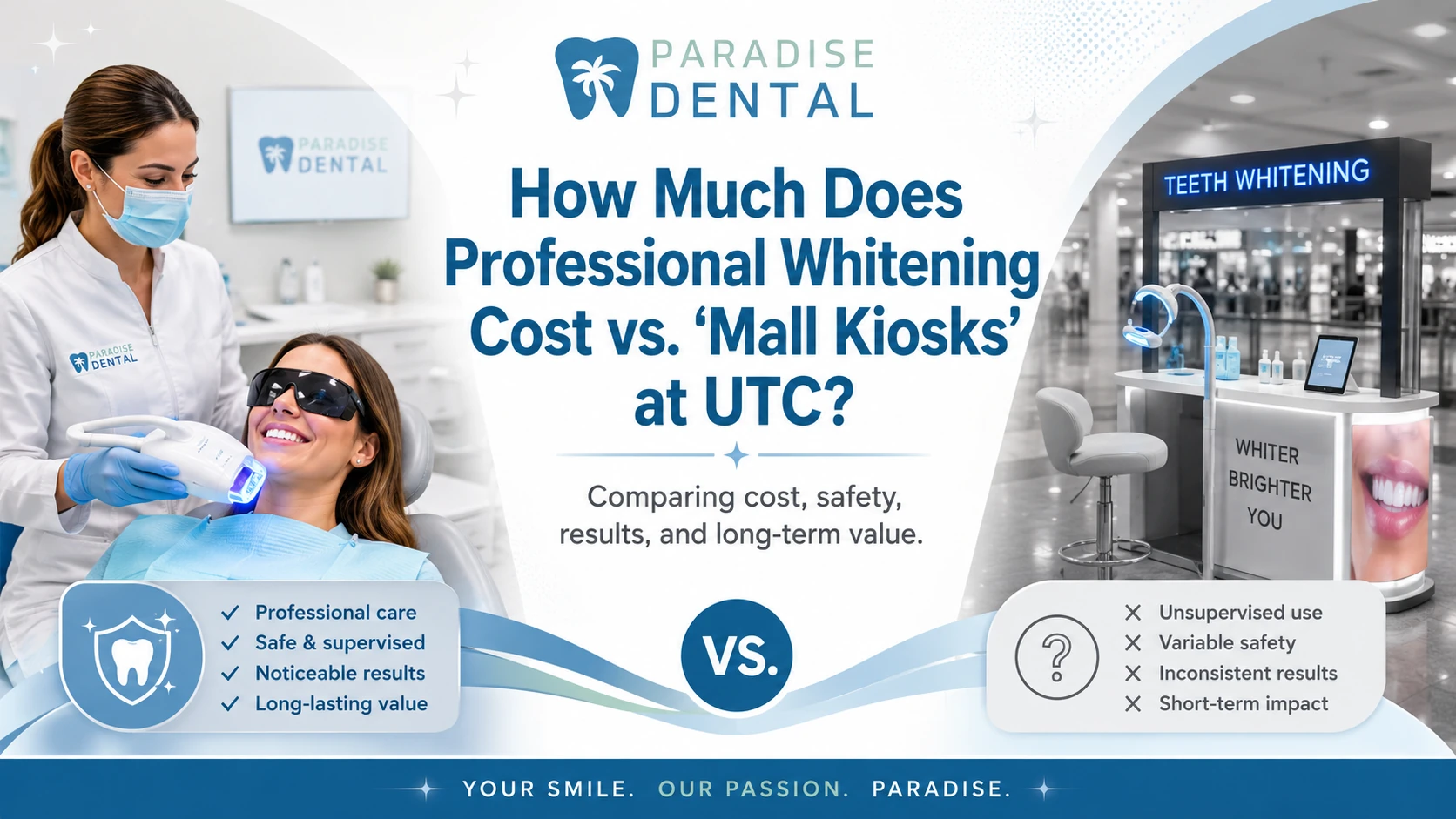
A lot of patients around Bradenton and Sarasota ask some version of the same question:
“If I can whiten my teeth at a mall kiosk or spa for a few hundred dollars, why would I pay more at a dental office?”
It is a fair question.
At University Town Center (UTC) and nearby shopping areas, patients regularly see:
- whitening kiosks
- LED whitening bars
- cosmetic spas
- over-the-counter kits
- influencer-promoted whitening systems
Some advertise dramatic whitening for a fraction of what a dentist charges.
Sometimes patients get decent short-term results.
Sometimes they end up with severe sensitivity, uneven whitening, irritated gums, or disappointment because the stains they actually wanted removed never responded in the first place.
The important question is not just price.
It is:
- what kind of whitening is being done,
- whether you are a good candidate,
- and whether the treatment is being supervised safely.
How Much Does Professional Teeth Whitening Cost in Bradenton?
For most patients in the Bradenton and Sarasota area:
- Mall kiosk whitening: typically $100–$300
- Store-bought kits/strips: roughly $30–$150
- Professional take-home whitening from a dentist: usually $300–$600
- In-office professional whitening: often $500–$1,000+
The price difference is real.
But so are the differences in:
- whitening strength
- customization
- safety
- gum protection
- predictability
- and long-term results
What Mall Kiosk Whitening Usually Involves
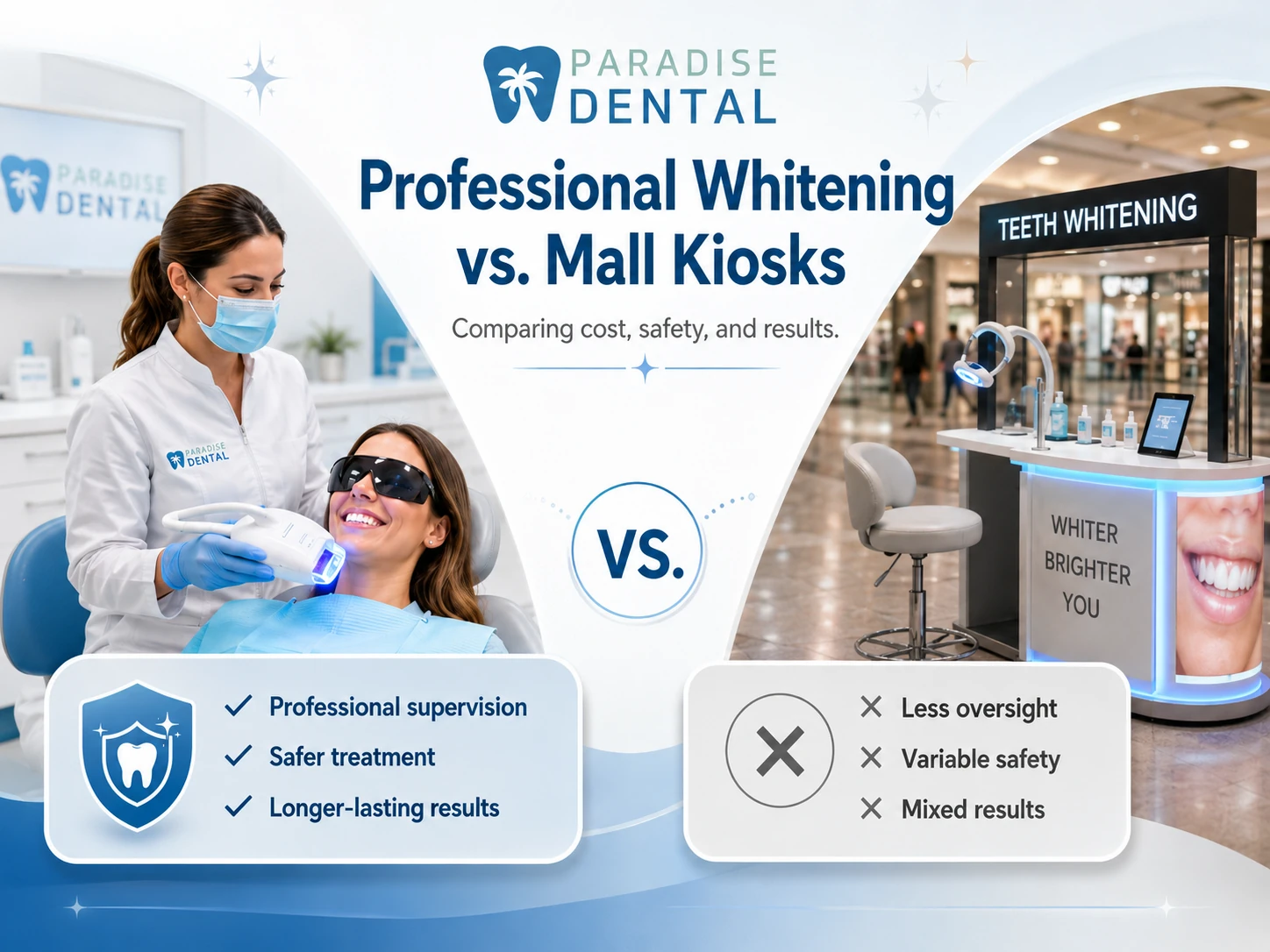
Most mall whitening systems use:
- lower-strength whitening agents
- generic trays
- LED lights
- short treatment sessions
The LED light is heavily marketed, but this is important:
The light itself is usually not the main whitening ingredient.
The peroxide or whitening gel does most of the work.
Many kiosk systems rely on lower concentrations because they are not operating under direct dental supervision.
That can reduce risk but it can also reduce effectiveness.
Some patients see mild brightening temporarily. Others notice very little change.
Why Some Teeth Do Not Respond Well to Cheap Whitening
This is one of the biggest misunderstandings in cosmetic dentistry.
Not all stains are the same.
Professional whitening works best on:
- yellow surface staining
- coffee staining
- tea staining
- mild age-related discoloration
But whitening is less predictable for:
- gray discoloration
- tetracycline staining
- fluorosis
- internal tooth darkening
- old dental bonding
- crowns
- veneers
This is where many patients waste money repeatedly trying over-the-counter or kiosk systems that were never likely to work well for their situation.
A good dentist should explain whether whitening is realistically capable of improving your smile before you spend money on it.
Why Professional Whitening Costs More
Professional whitening is not just stronger gel.
At Paradise Dental, whitening recommendations are based on:
- enamel condition
- gum health
- existing restorations
- sensitivity history
- staining type
- bite wear
- recession
- and cosmetic goals
That matters because aggressive whitening on unhealthy teeth can create serious sensitivity problems.
Professional whitening also typically includes:
- custom trays
- stronger professional-grade whitening agents
- gum protection
- supervised application
- more even results
- and guidance for maintenance
For some patients, take-home whitening supervised by a dentist actually produces the best combination of comfort and long-term results.
Others prefer faster in-office whitening before weddings, events, vacations, or photos.
The Cheapest Whitening Option Is Not Always the Lowest-Cost Option
Many patients spend years cycling through:
- whitening strips
- LED gadgets
- whitening toothpastes
- mall kiosks
- online kits
Sometimes they spend more cumulatively than they would have on properly supervised whitening.
More importantly, they often become frustrated because:
- results plateau
- sensitivity increases
- or the teeth never whiten evenly
That does not mean every patient needs premium whitening.
For some patients, over-the-counter whitening works reasonably well.
A good dentist should be honest about that.
Whitening Can Also Reveal Other Cosmetic Problems
This surprises patients sometimes.
After whitening, people occasionally notice:
- old fillings look darker
- crowns no longer match
- chipped edges stand out more
- uneven wear becomes more visible
Whitening only affects natural tooth structure.
It does not whiten:
- crowns
- veneers
- bonding
- fillings
That is why cosmetic planning matters, especially for highly visible front teeth.
Is Mall Whitening Unsafe?
Not necessarily.
But there are limitations.
Many kiosk operators are not dental professionals. That means they may not identify:
- cavities
- gum disease
- cracked teeth
- exposed roots
- or conditions causing discoloration
Some patients should not whiten until underlying problems are treated first.
This is particularly true for patients with:
- severe recession
- untreated decay
- enamel erosion
- cracked teeth
- or heavy sensitivity
The issue is not always danger.
It is whether the whitening approach fits the patient properly.
So Which Option Makes More Sense?
For most patients, the realistic answer depends on goals.
Mall kiosk whitening may make sense if:
- you want mild short-term brightening
- your teeth are already healthy
- you have low sensitivity
- and expectations are modest
Professional whitening usually makes more sense if:
- discoloration is significant
- you have dental work on front teeth
- you want more predictable results
- you have sensitivity concerns
- or you are investing in a larger cosmetic improvement
At Paradise Dental in Bradenton, Dr. Jeffrey Martins helps patients understand:
- whether whitening is likely to work well,
- what type of discoloration they actually have,
- what realistic results look like,
- and when simpler or lower-cost options may still be reasonable.
Because cosmetic dentistry should not be about overselling treatment.
It should be about helping patients make informed decisions about what is actually worth the investment for their smile.