Parents in Lakewood Ranch usually are not looking for a perfect snack list.
They are looking for snacks their kids will actually eat after school, before soccer, between errands, or during a Sunday morning at Waterside Place without feeling like every bite is another cavity waiting to happen.
Here is the honest answer:
No snack is completely “cavity-proof.” Even healthy foods can contain natural sugars. But some snacks are much easier on teeth than sticky, sugary, slow-dissolving foods that sit in the grooves of molars for hours. The ADA notes that a balanced diet low in added sugars supports children’s dental and overall health, while the AAPD emphasizes low-caries-risk, nutrient-dense foods for children and adolescents.
The goal is not to ban treats.
The goal is to choose snacks that do not feed cavity-causing bacteria all afternoon.
First: What Makes a Snack Better for Teeth?
A tooth-friendlier snack usually has one or more of these qualities:
- low in added sugar
- not sticky
- not highly acidic
- does not cling to teeth
- contains protein, fat, fiber, calcium, or water
- is eaten at a snack time instead of grazed on all day
That last one matters.
The AAPD specifically warns that frequent access to snacks and sweetened beverages can increase cavity risk because teeth are exposed more often throughout the day.
So the issue is not just what your child eats.
It is also how often they snack.
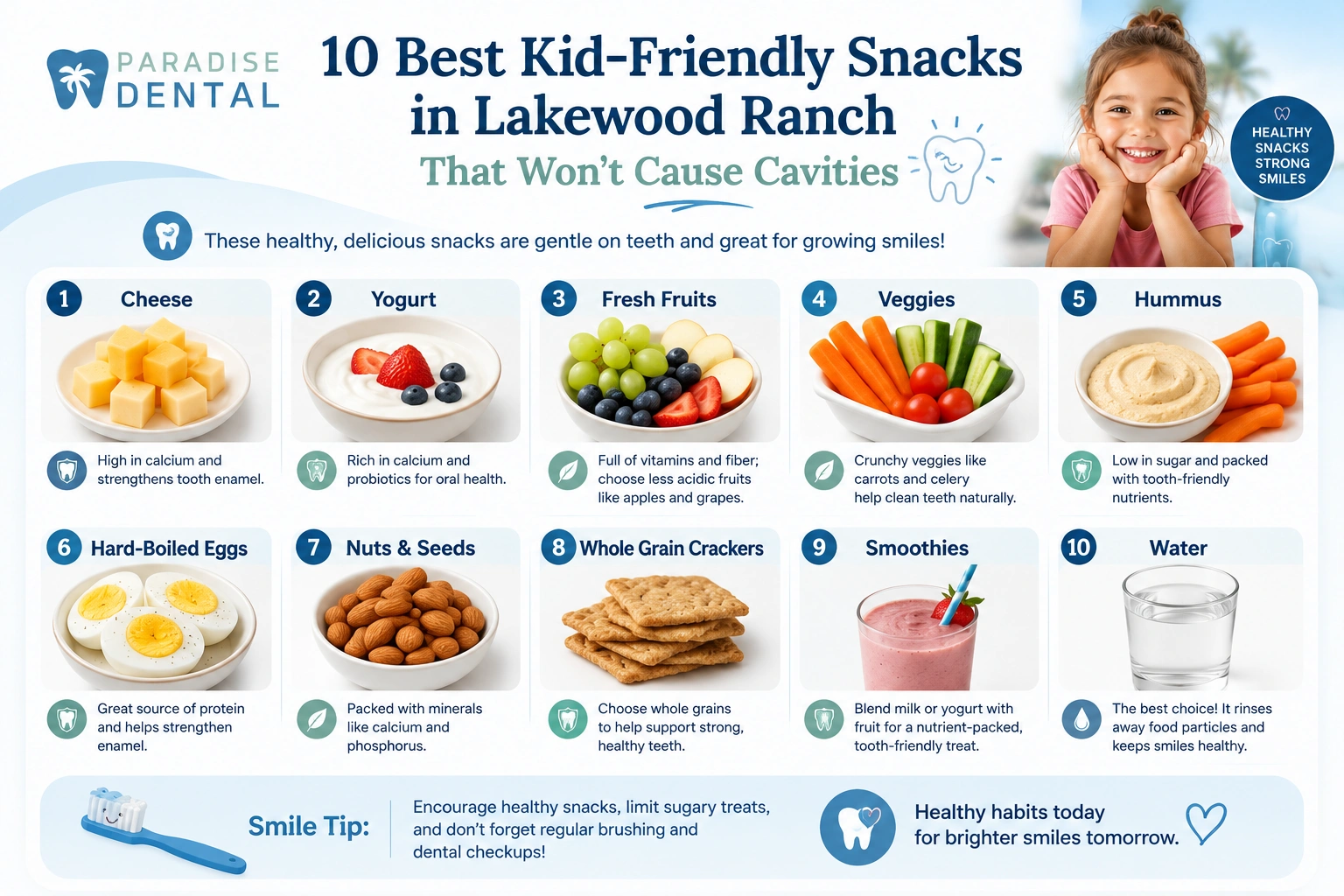
1. Cheese Cubes or String Cheese
Cheese is one of the easiest kid-friendly snack wins.
It is portable, filling, low in sugar, and less likely to stick in teeth compared with crackers, gummies, or fruit snacks.
For Lakewood Ranch parents running from school pickup to practice, string cheese is about as practical as it gets.
Why it helps:
- low sugar
- calcium-rich
- protein-rich
- easy to pack
Just watch flavored cheese snacks or highly processed snack packs that come with sugary extras.
2. Plain Greek Yogurt With Fresh Berries
Yogurt can be a great snack or it can quietly become dessert.
The difference is usually added sugar.
Plain Greek yogurt with fresh berries is a better choice than tubes, drinkable yogurts, or candy-flavored cups. Many sweetened yogurts marketed to kids contain more sugar than parents realize.
A good option:
- plain Greek yogurt
- strawberries, blueberries, or banana slices
- a small drizzle of honey only if needed for older kids
For very young children, ask your pediatrician or dentist about age-appropriate foods and choking risks.
3. Apple Slices With Peanut Butter
Apples are not sugar-free, but they are high in water and fiber.
Pairing apple slices with peanut butter makes the snack more filling and helps avoid the “carb-only snack” problem that leaves kids hungry 20 minutes later.
A few notes:
- choose peanut butter without added sugar when possible
- slice apples thin for younger kids
- avoid sticky caramel or sweet dips
This is a much better after-school choice than fruit snacks, fruit roll-ups, or sticky dried fruit.
4. Baby Carrots With Hummus
Crunchy vegetables are a strong snack choice because they are not sticky and do not bathe the teeth in sugar.
Baby carrots with hummus work well for kids who like dipping.
Other options:
- cucumber slices
- bell pepper strips
- snap peas
- celery with cream cheese or nut butter
This is also a good snack to pick up at local grocery stops around Lakewood Ranch. Publix at Lakewood Ranch Town Center lists produce among its store departments, and Trader Joe’s Lakewood Ranch notes that it carries everyday basics including fresh produce.
5. Hard-Boiled Eggs
Hard-boiled eggs are not flashy, but they are one of the most practical tooth-friendly snacks.
They are:
- low in sugar
- high in protein
- filling
- easy to prep ahead
For kids who do not like plain eggs, try a little salt, everything seasoning, or slicing them into a bento-style lunch box with cheese and fruit.
The cavity advantage is simple: eggs do not cling to molars like crackers, cookies, or gummy snacks.
6. Nuts or Nut-Based Snack Mixes
For kids old enough to eat nuts safely, almonds, cashews, walnuts, or pistachios can be a good snack.
The key is choosing versions that are not candied, chocolate-covered, honey-roasted, or mixed with sticky dried fruit.
Better choice:
- plain or lightly salted nuts
- cheese
- fresh fruit
- whole-grain crackers in moderation
Less ideal:
- trail mix with chocolate chips
- yogurt-covered raisins
- sticky dried cranberries
- sweet granola clusters
Those “healthy” snack mixes can behave more like candy from a dental standpoint.
7. Turkey or Chicken Roll-Ups
Deli turkey or chicken wrapped around cheese is a solid snack for kids who want something savory.
It is low in sugar, quick to prepare, and more filling than chips or crackers.
A simple version:
- turkey slice
- cheese slice
- cucumber stick inside
- rolled up and cut into bite-size pieces
This can be especially helpful for kids who snack heavily after school because they are genuinely hungry, not just bored.
8. Fresh Fruit Instead of Dried Fruit
Fresh fruit is usually a better dental choice than dried fruit.
Why?
Dried fruit is concentrated, sticky, and can wedge into the grooves of back teeth. Fresh fruit has more water and is less likely to cling as long.
Better options:
- orange slices
- watermelon
- strawberries
- blueberries
- apple slices
- pear slices
Use a little caution with citrus. It is healthy, but it is acidic. For kids who eat a lot of oranges, grapefruit, or lemon-flavored drinks, have them rinse with water afterward instead of brushing immediately.
9. Whole-Grain Toast With Avocado or Cream Cheese
Crackers are one of the sneakiest cavity foods because they break down into a sticky starch that can pack into the molars.
That does not mean kids can never have crackers.
But if your child eats crackers every afternoon, switching some days to whole-grain toast with avocado, cream cheese, or nut butter may be a better option.
The goal is to avoid the constant pattern of:
cracker snack
plus juice box
plus another cracker snack
plus sports drink
That is where cavity risk starts climbing.
10. Farmers’ Market Produce Snacks
Lakewood Ranch families have an advantage here.
The Farmers’ Market at Lakewood Ranch is held Sundays at Waterside Place and features local vendors, produce, prepared foods, and family-friendly activities. Visit Sarasota County describes the market as having 100+ local vendors, including organic produce, fresh bread, baked goods, prepared foods, honey, and more.
From a dental perspective, the best market snacks are usually:
- fresh fruit cups without syrup
- veggie cups
- cheese-based snacks
- nut mixes without candy
- protein-forward prepared foods
- water instead of lemonade or sweet tea
The baked goods are fine as occasional treats.
They just should not become an all-day grazing situation.
Snacks That Look Healthy But Can Be Hard on Teeth
This is where parents often get surprised.
Some snacks marketed as “better” can still raise cavity risk if kids eat them often.
Be careful with:
- fruit snacks
- fruit leathers
- raisins and dried mango
- sweetened yogurt tubes
- granola bars
- gummy vitamins
- juice pouches
- sports drinks
- crackers eaten throughout the day
The problem is not that these foods are forbidden.
The problem is frequency and stickiness.
A gummy snack eaten once with lunch is different from a child slowly eating sticky snacks all afternoon.
The Paradise Dental Rule for Kids’ Snacks
At Paradise Dental, the practical rule would be:
Choose snacks that are less sticky, less sugary, and eaten at set times then have kids drink water afterward.
Water matters, especially in Florida. Kids are active, hot, sweaty, and often carrying sports bottles around Lakewood Ranch. Water helps rinse food particles and supports saliva, which is one of the mouth’s natural defenses.
For most families, cavity prevention does not come from perfect snacks.
It comes from:
- consistent brushing
- flossing once teeth touch
- fluoride toothpaste
- routine cleanings
- sealants when appropriate
- fewer sticky snacks
- fewer sugary drinks
- less all-day grazing
When Snack Habits Need a Dental Conversation
If your child keeps getting cavities despite brushing, the issue may not be brushing alone.
Dr. Jeffrey Martins and the Paradise Dental team would look at:
- snack frequency
- juice or sports drink habits
- brushing technique
- fluoride exposure
- deep grooves in molars
- dry mouth
- enamel strength
- orthodontic appliances
- family cavity patterns
That does not mean parents are doing something wrong.
It means the child’s cavity risk needs to be understood clearly.
Because the best snack plan is not the strictest one.
It is the one your family can actually follow while keeping your child’s teeth healthy.