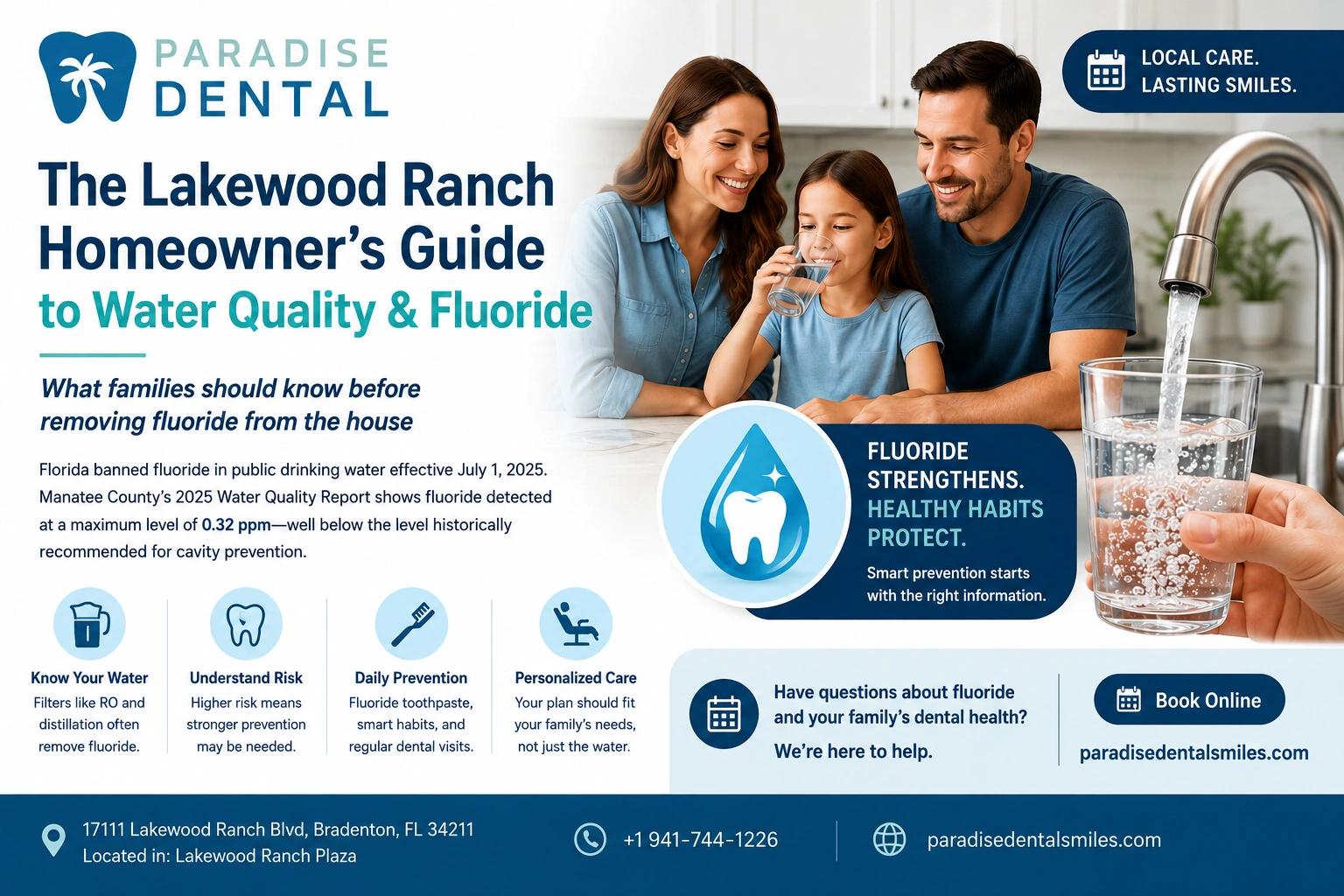
What families should know before removing fluoride from the house
Most Lakewood Ranch homeowners think about water quality in terms of taste, smell, hardness, chlorine, filters, plumbing, or bottled water.
Dentists think about one more thing:
Is your family still getting enough fluoride to help prevent cavities?
That question matters more now because Florida banned the addition of fluoride to public drinking water effective July 1, 2025, and Manatee County’s 2025 water quality report showed fluoride detected at a maximum level of 0.32 ppm, well below the federal public-health recommendation historically used for cavity prevention.
Here is the practical answer:
If your Lakewood Ranch home uses public water, a whole-house filter, reverse osmosis system, bottled water, or well water, you should not assume your family is getting cavity-preventive fluoride from drinking water.
That does not mean you need to panic. It means your prevention plan may need to come from toothpaste, dental visits, diet habits, professional fluoride when appropriate, and risk-based guidance from your dentist.
First: is Lakewood Ranch water fluoridated?
For many Lakewood Ranch and Bradenton residents served by Manatee County Utilities, the current practical answer is: do not count on your tap water as a reliable fluoride source for cavity prevention.
Manatee County’s 2025 Water Quality Report lists fluoride with a maximum detected level of 0.32 ppm and a range of not detected to 0.32 ppm. The report also states Manatee County met EPA and state drinking water health standards in 2025.
That distinction matters.
Water can meet safety standards and still not contain the fluoride level historically recommended to help reduce tooth decay.
The U.S. Public Health Service recommendation for community water fluoridation has been 0.7 mg/L, which is the same as 0.7 ppm. That level was chosen to help prevent cavities while limiting fluorosis risk.
So if your water report says 0.32 ppm or less, that is not the same as optimally fluoridated water for dental prevention.
Why dentists care about fluoride in the first place
Fluoride helps teeth because cavities are not just “holes.”
A cavity starts when acids from bacteria pull minerals out of enamel. Fluoride helps strengthen enamel and supports remineralization, which is the process of putting minerals back into weakened tooth structure before it becomes a larger cavity. The CDC describes community water fluoridation as a long-standing public health practice that benefits dental health, and the National Institute of Dental and Craniofacial Research says fluoridation helps prevent tooth decay and supports oral health for all ages.
That does not mean fluoride is magic.
Fluoride does not cancel out frequent sugar, dry mouth, poor brushing, untreated gum disease, or skipped dental care. It is one layer of protection.
For low-risk adults with great home care, the difference may be small. For children, seniors, dry-mouth patients, people with exposed roots, orthodontic patients, and adults with a history of cavities, the difference can matter.
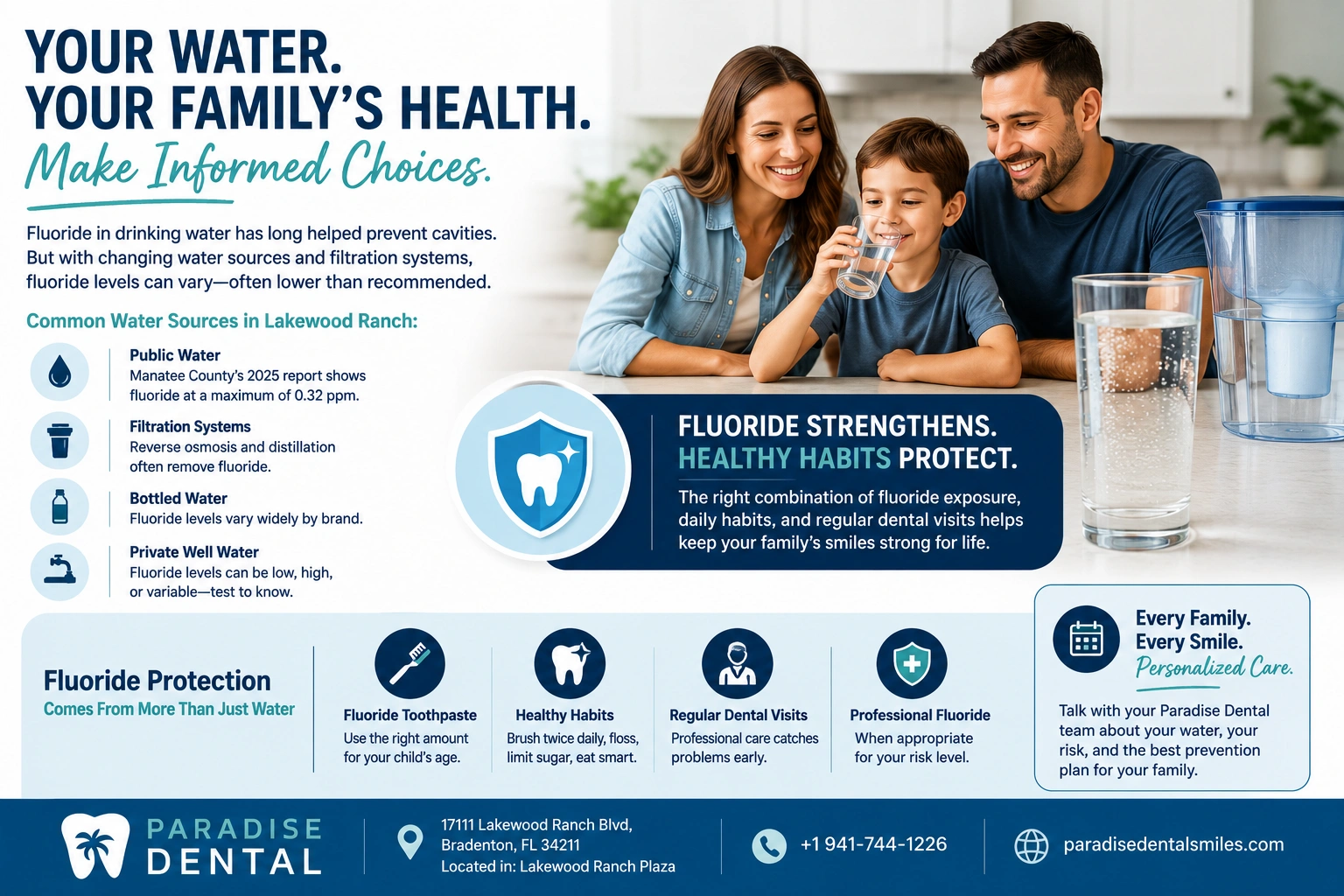
The homeowner problem: filters can change the fluoride conversation
Many Lakewood Ranch homeowners use water treatment systems for reasonable reasons.
The water may taste better. It may reduce odor. It may protect appliances. It may help with hardness. It may make coffee taste better. It may reduce certain contaminants depending on the system.
The dental question is different:
Does your water treatment system remove fluoride?
Some systems do. Some do not.
Here is the simple version:
| Water setup | Dental fluoride concern |
| Standard refrigerator carbon filter | Usually not designed primarily to remove fluoride |
| Pitcher filter | Depends on brand and filter type |
| Reverse osmosis system | Often removes a large portion of fluoride |
| Distillation | Removes fluoride |
| Whole-house filtration | Depends on system design |
| Water softener | Usually addresses hardness, not fluoride directly |
| Bottled water | Fluoride level varies widely |
| Private well | Must be tested; fluoride may be low, high, or variable |
The important question is not, “Do we have filtered water?”
It is:
“What exactly is this filter removing?”
If you installed reverse osmosis under the kitchen sink and your kids drink mostly that water, they may be getting very little fluoride from drinking water. That may be fine if they are using the right toothpaste and seeing a dentist regularly. It may not be fine if they are cavity-prone, snack frequently, or brush inconsistently.
Is fluoride-free water bad?
No. Fluoride-free water is not automatically bad.
Plenty of families drink filtered or bottled water and do well dentally. The issue is whether you have replaced the lost fluoride protection with something else.
For example, a low-cavity-risk adult who brushes twice daily with fluoride toothpaste, flosses, avoids frequent snacking, and sees the dentist regularly may not need to worry much.
A 7-year-old with early cavities, a teenager in clear aligners, or a retiree with dry mouth from medications may need a stronger prevention plan.
This is where the recommendation changes.
The same water setup can be perfectly reasonable for one household and a cavity risk for another.
Who should pay closer attention?
Fluoride matters most when cavity risk is higher.
At Paradise Dental, Dr. Jeffrey Martins or a Paradise Dental clinician would be more likely to discuss fluoride exposure if you or a family member has:
- new cavities at recent visits
- white chalky spots on teeth
- exposed roots from gum recession
- dry mouth from medications
- radiation history to the head or neck
- braces, Invisalign, or retainers
- frequent sipping of sports drinks, sweet tea, soda, or coffee with sugar
- frequent snacking
- trouble brushing well because of age, arthritis, disability, or dexterity issues
- a history of root cavities
- many crowns, bridges, or fillings
- young children still learning to brush
For these patients, removing fluoride from the water may not be the only issue, but it can remove a quiet layer of protection.
What about kids and fluoride toothpaste?
For most families, fluoride toothpaste becomes even more important when water fluoride is low or unreliable.
The key is using the right amount.
The American Dental Association recommends brushing twice a day with fluoride toothpaste and gives age-based guidance for children: a smear about the size of a grain of rice for children under 3, and a pea-sized amount for children ages 3 to 6.
Parents should supervise young children so they spit instead of swallowing large amounts of toothpaste.
That is the balance. You want enough fluoride to protect enamel. You do not want young children eating toothpaste.
A dentist can help you decide whether your child needs only normal fluoride toothpaste or additional prevention based on cavity risk.
What about fluoride treatments at the dentist?
Professional fluoride may be reasonable for children and some adults at higher cavity risk.
This does not mean every adult automatically needs fluoride varnish at every visit. It depends on risk.
A dentist may recommend professional fluoride if you have:
- recurring cavities
- exposed root surfaces
- dry mouth
- orthodontic appliances
- many restorations
- high sugar or acid exposure
- difficulty cleaning well
- early enamel weakening
That does not mean fluoride is a substitute for fixing the cause. If someone is getting cavities because they sip sweet drinks all day, fluoride may help, but the habit still needs to change.
A good dentist should explain both.
Private wells in Lakewood Ranch and east Manatee County
Some homes outside dense public utility areas may use private wells.
Private well water is different because the homeowner is responsible for testing. Fluoride may be naturally present, low, high, or inconsistent depending on the groundwater source.
The CDC advises private well owners to test their water for fluoride if they want to know the level, because private wells are not covered by the same public water reporting requirements.
For families with children, this matters.
If fluoride is very low, the child may not get water-based fluoride protection. If fluoride is too high, there may be a fluorosis concern while adult teeth are developing.
The honest answer is: test the water before guessing.
What about bottled water?
Bottled water is not automatically better for teeth.
Some bottled waters contain fluoride. Some contain very little. Some labels do not make the dental picture obvious.
If your family drinks mostly bottled water, especially young children, it is worth checking the brand’s water quality report or asking your dentist whether your child’s cavity risk suggests a need for additional fluoride.
This is especially relevant for families who switched to bottled water because they do not like the taste of tap water.
From a dental standpoint, the question is not whether bottled water is “clean.” The question is whether the household has lost a source of fluoride and whether that matters for that patient.
Should Lakewood Ranch homeowners remove fluoride from their water?
In 2026, many Florida homeowners are not deciding whether to remove added fluoride from municipal water because state law has already changed public fluoridation policy. Florida became the second state to ban local governments from adding fluoride to public water systems, with the law taking effect July 1, 2025.
The more common homeowner decision is now about filters, reverse osmosis, bottled water, and private wells.
A reverse osmosis system may be a good choice for taste or specific water concerns. But from a dental standpoint, you should know that it may reduce fluoride exposure.
That does not mean you should remove the system. It means you should adjust prevention if needed.
A good dental conversation sounds like this:
“Your water setup is fine, but because your child has had cavities, let’s make sure brushing, toothpaste amount, diet, and fluoride exposure are appropriate.”
Not:
“Your filter is bad.”
Home water choices are personal. Dental prevention should be personalized too.
What should you ask your water filter company?
Before buying or relying on a water system, ask for specifics.
Ask:
- Does this system remove fluoride?
- If yes, how much fluoride does it remove?
- Is the claim certified by an independent testing standard?
- Does it treat the whole house or only one faucet?
- Does the refrigerator filter remove fluoride?
- How often must filters be replaced?
- Can I get a post-filtration water test?
- Is the system designed for taste, hardness, lead, PFAS, chlorine, bacteria, or fluoride?
Do not assume all filters do the same job.
A softener, carbon filter, reverse osmosis unit, UV system, and whole-house filtration system are not interchangeable.
What should you ask your dentist?
If you live in Lakewood Ranch, Bradenton, Parrish, Sarasota, or anywhere in Manatee County, these are fair questions:
“Do you consider our local water fluoride level when evaluating cavity risk?”
“Does my child need any fluoride beyond toothpaste?”
“Does my reverse osmosis system change your recommendation?”
“Are these new cavities from diet, dry mouth, brushing, genetics, old dental work, or lack of fluoride exposure?”
“Can we avoid unnecessary treatment if we improve prevention now?”
Those questions are better than simply asking, “Is fluoride good or bad?”
For most patients, the practical question is risk.
The Paradise Dental view
At Paradise Dental, the goal is not to argue politics at the dental chair.
The goal is to help patients make smart, practical decisions for their mouths.
For a low-risk adult, low-fluoride water may not change much. For a child with early cavities, a teenager in aligners, or an older adult with dry mouth and root exposure, it may matter more.
Dr. Jeffrey Martins and the Paradise Dental team would look at:
- your cavity history
- gum recession
- dry mouth
- medications
- diet habits
- brushing and flossing
- orthodontic appliances
- old dental work
- whether you use reverse osmosis or bottled water
- whether children in the home are using the right toothpaste amount
That is how the recommendation should be made.
Not based on fear. Not based on one-size-fits-all advice.
The bottom line for Lakewood Ranch homeowners
Lakewood Ranch homeowners should not assume their tap water, filtered water, bottled water, or well water is providing cavity-preventive fluoride.
Manatee County’s 2025 report showed fluoride levels up to 0.32 ppm, and Florida law now prevents public water systems from adding fluoride for health benefits.
That does not mean every family needs supplements or extra treatment.
It means fluoride should be part of your prevention conversation, especially if someone in the home is cavity-prone.
If you are unsure where your household falls, the next step is not guessing. It is a dental exam, a cavity-risk discussion, and a clear prevention plan that fits your water, your habits, and your family.