The Paradise Dental No-Judgment Guide for Bradenton Patients
If it has been 10 years since your last dental visit, you are not the only one.
Some people stay away because of cost. Some had a bad experience years ago. Some are embarrassed about broken teeth, bleeding gums, bad breath, or what the dentist might say. Others simply got busy, moved, lost insurance, started caring for family, or kept putting it off until “next year.”
Here is the honest answer:
A good dental office should not shame you for being overdue. The first visit should be about figuring out what is happening, what is urgent, what can wait, and what your options are.
At Paradise Dental in Bradenton, the goal is not to lecture you. It is to help you get a clear picture of your mouth and make a plan that fits your health, timeline, and budget. That patient-first approach is part of the content philosophy for Paradise Dental: answer the real concern before asking someone to schedule.
First, nothing you say will surprise a good dentist
Patients often imagine the worst.
They think:
“My teeth are probably the worst they’ve seen.”
“They’re going to judge me.”
“They’ll tell me I need everything done at once.”
“I can’t afford what they’re going to recommend.”
“I’m afraid they’ll make me feel guilty.”
For most people, the fear before the visit is worse than the visit itself.
Dental teams see overdue patients every week. They see broken teeth, old fillings, gum disease, missing teeth, cavities, anxiety, and people who have not been in 5, 10, 20, or even 30 years.
The question is not, “Why did you wait so long?”
The useful question is, “What is happening now, and what is the most practical next step?”
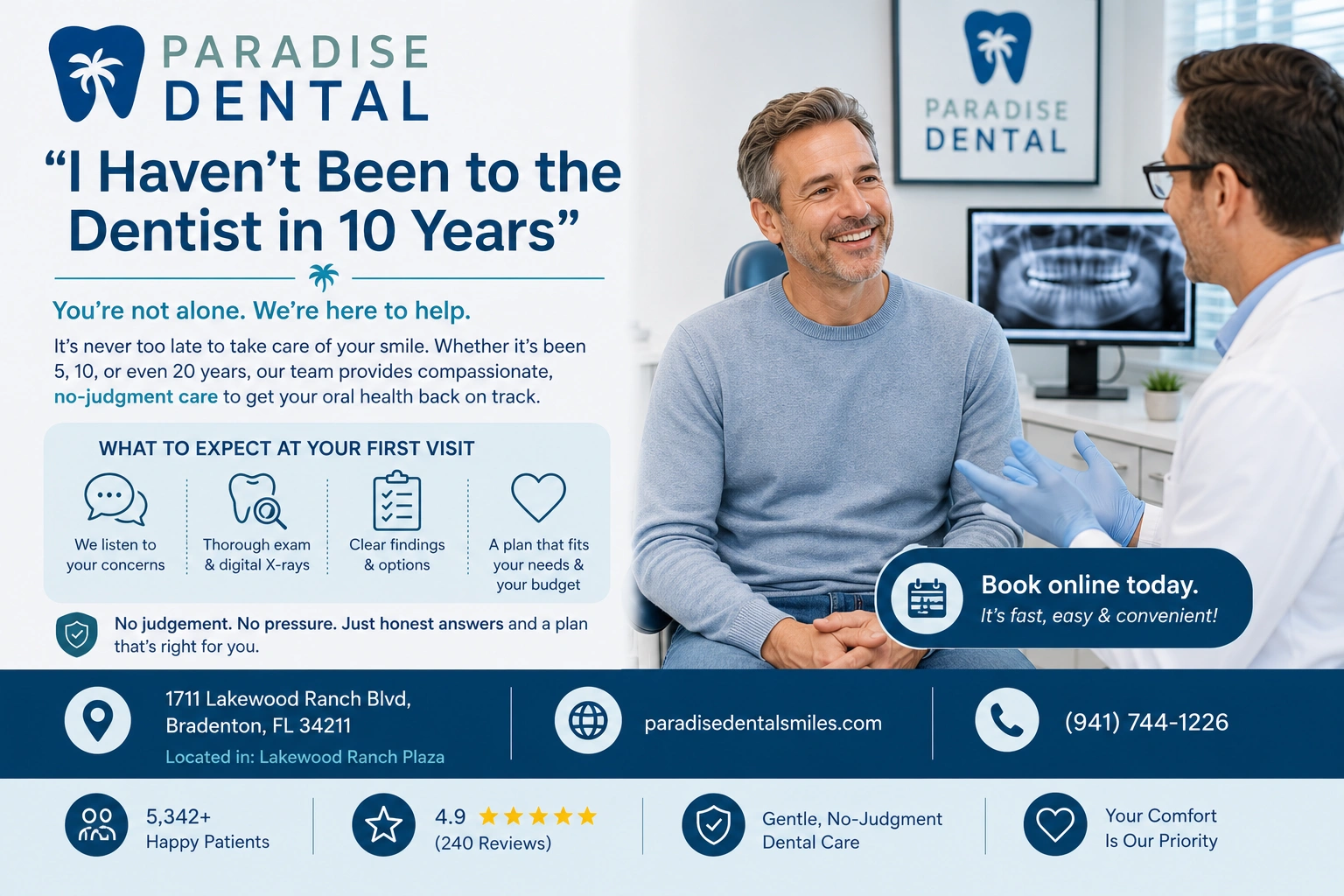
What usually happens at your first visit after 10 years?
Your first visit is usually not about doing everything that day.
It is about diagnosis.
A proper exam may include:
- a conversation about your concerns
- review of medical history and medications
- digital X-rays
- gum measurements
- checking for cavities
- checking old fillings, crowns, and bridges
- evaluating broken or worn teeth
- looking for signs of infection
- oral cancer screening
- bite and grinding evaluation
- discussion of pain, sensitivity, bleeding, or loose teeth
- a treatment plan, if treatment is needed
The ADA’s consumer resource, MouthHealthy, emphasizes that dental visits help maintain oral health and address common adult dental concerns. The CDC also notes that oral health affects quality of life and that oral disease can cause pain, infection, and problems with eating and speaking.
At Paradise Dental, Dr. Jeffrey Martins or a Paradise Dental clinician would want to understand the full picture before recommending treatment. That matters because two patients can both say, “I haven’t been in 10 years,” and need very different levels of care.
Will they clean my teeth the same day?
Maybe. Maybe not.
This is one of the most common misunderstandings.
If your gums are healthy enough and the buildup is moderate, a regular cleaning may be possible.
But if there is heavy tartar under the gums, bleeding, bone loss, deep pockets, or signs of periodontal disease, a standard cleaning may not be the right treatment. You may need a deeper gum therapy approach first.
That is not punishment. It is because a regular cleaning is designed for relatively healthy gums. If bacteria and tartar are trapped below the gumline, polishing the teeth without addressing the deeper infection does not solve the problem.
The CDC explains that periodontal disease involves inflammation and infection of the gum and bone that support the teeth, and that regular dental care helps with prevention and treatment.
A good dental office should explain this clearly, not make you feel like you “failed” at brushing.
What problems are common after 10 years away?
Not everyone who skips the dentist for 10 years has major problems.
Some patients are pleasantly surprised. They may need a cleaning, a few fillings, or replacement of old dental work.
Others may have several things going on at once.
Common findings include:
| What the dentist may find | What it usually means |
| Tartar buildup | Hardened plaque that cannot be brushed off at home |
| Bleeding gums | Often inflammation; sometimes gum disease |
| Cavities | Decay that may need fillings, crowns, or other care |
| Broken fillings | Old dental work may be leaking or fractured |
| Cracked teeth | Often related to grinding, old fillings, or bite pressure |
| Gum recession | Exposed roots can cause sensitivity and higher cavity risk |
| Bone loss | Possible periodontal disease |
| Loose teeth | Often advanced gum/bone support issues |
| Missing teeth | May affect chewing, bite, and tooth shifting |
| Bad breath | Can come from gum disease, decay, dry mouth, or buildup |
The important part is sorting these into categories.
Some things are urgent. Some are important but not immediate. Some can be watched. Some may not need treatment at all.
What should you not ignore?
You do not need to panic. But some symptoms should be checked sooner rather than later.
Call a dentist if you have:
- swelling in the face, jaw, or gums
- severe tooth pain
- pain that wakes you up
- a pimple-like bump on the gums
- a broken tooth with pain
- loose adult teeth
- pus, bad taste, or drainage
- bleeding gums that happen often
- difficulty chewing
- dentures or partials that no longer fit
- a sore spot in the mouth that does not heal
Dental infections can sometimes spread beyond the tooth, so swelling, fever, worsening pain, or trouble swallowing should be taken seriously.
That does not mean every dental problem is an emergency. It means the first job is to determine what category you are in.
What if you are embarrassed about your teeth?
This is one of the biggest reasons people delay care.
You may feel embarrassed about:
- stained teeth
- missing teeth
- bad breath
- broken teeth
- black spots or visible decay
- dentures
- not flossing
- smoking history
- dry mouth
- past drug use
- not having insurance
- not knowing where to start
A good dentist should not use shame as a treatment plan.
Shame does not fix teeth. A clear diagnosis, honest priorities, and realistic steps do.
At Paradise Dental, the first conversation should feel more like:
“Here is what we see.”
“Here is what is healthy.”
“Here is what concerns us.”
“Here is what should be treated first.”
“Here is what can wait.”
“Here are the options.”
Not:
“You should have come in sooner.”
Most patients already know that.
Will the dentist tell me I need thousands of dollars of work?
Maybe you will need treatment. Maybe you will not.
After 10 years, it is possible that you may need more than a basic cleaning. But that does not mean everything has to be done immediately.
A thoughtful dental plan should separate care into priorities:
1. Urgent problems
These are things like infection, swelling, severe pain, broken teeth with symptoms, or teeth at risk of being lost soon.
These usually come first.
2. Disease control
This includes gum treatment, cavities, failing fillings, and areas where decay is active.
This is about stopping problems from getting worse.
3. Function
This may involve replacing missing teeth, restoring chewing ability, fixing bite problems, or protecting cracked teeth.
4. Cosmetic goals
Whitening, veneers, bonding, smile makeovers, and cosmetic improvements usually come after the mouth is stable.
That order matters.
For example, it usually does not make sense to start with veneers if the gums are infected or the bite is unstable. It may not make sense to place an implant until gum health and bone support are understood.
What if you cannot afford to do everything?
This is where a good dental office should be practical.
Many patients are afraid that if they cannot afford the full plan, there is no point in coming in.
That is not true.
A first visit can still help you understand:
- what is urgent
- what is optional
- what can be phased
- what has cheaper alternatives
- what should not be delayed
- what insurance may help with
- what can be monitored safely
Sometimes the lowest-cost option is reasonable.
For example, a removable partial denture may be a practical temporary choice instead of implants. A filling may be reasonable if a tooth still has enough structure. A nightguard may help protect teeth from grinding before larger restorative work is considered.
Other times, the cheapest option creates problems later.
For example, repeatedly patching a badly cracked tooth may delay the inevitable and cost more over time. Ignoring gum disease may make future implants, bridges, or dentures more complicated.
A good dentist should explain both sides without pressure.
What if you are afraid of pain?
Dental anxiety is real.
Cleveland Clinic describes dentophobia as fear of the dentist, often connected to past negative experiences or feeling a loss of control. Research also recognizes dental anxiety as a barrier that can keep adults from seeking dental care.
If you are nervous, say that early.
You can ask:
- “Can you explain what you’re doing before you do it?”
- “Can we take breaks?”
- “Can I raise my hand if I need you to stop?”
- “What are my numbing options?”
- “Do you offer anything for anxiety?”
- “Can we start with just an exam and talk?”
A no-judgment dental office should respect that.
For many anxious patients, the best first step is not treatment. It is simply getting through the exam, meeting the team, and understanding what is happening.
That counts as progress.
What if the dentist finds gum disease?
Do not assume that means you are going to lose your teeth.
Gum disease exists on a spectrum.
Mild gum inflammation may improve with proper cleaning and better home care. More advanced periodontal disease may require deeper cleaning, ongoing maintenance, and closer monitoring.
The CDC reports that nearly half of adults age 30 and older have periodontitis, with severe periodontitis affecting a smaller percentage of adults. In other words, gum disease is common. It is not a personal failure.
The key question is how advanced it is and whether it is active.
A dentist may evaluate:
- pocket depths around teeth
- bleeding points
- tartar below the gums
- gum recession
- bone levels on X-rays
- tooth mobility
- smoking history
- diabetes or other health factors
- home care habits
The treatment recommendation should match the severity.
What if you need teeth removed?
This is another major fear.
Patients often worry they will be told, “All your teeth have to come out.”
Sometimes teeth truly cannot be saved. But a responsible dentist should explain why.
A tooth may need removal if it has:
- severe bone loss
- a deep crack below the gumline
- infection that cannot be predictably treated
- decay too deep to restore
- mobility that makes it unstable
- failed previous treatment with poor prognosis
But extraction should not be presented casually.
A good dentist should explain:
- whether the tooth can be saved
- what saving it would involve
- what the long-term outlook is
- what happens if it is removed
- replacement options
- what happens if you do nothing
That does not automatically mean implants are the only answer. Depending on the case, options may include a bridge, partial denture, full denture, implant, or simply monitoring the space for a period of time.
How to prepare for your first dental visit after 10 years
You do not need to fix everything before you go.
You do not need to apologize.
You do not need to over-explain.
You do not need to be embarrassed that you flossed the night before.
Just come in with honest information.
Helpful things to bring:
- your dental insurance card, if you have one
- a list of medications
- medical conditions your dentist should know about
- previous dental records, if available
- your biggest concern
- your budget concerns
- your anxiety concerns
- a list of symptoms and how long they have been happening
You can also say at the beginning:
“I haven’t been in a long time, and I’m nervous. I need you to explain things clearly and not overwhelm me.”
That is a fair request.
What a good no-judgment dental visit should feel like
A good visit should be calm, organized, and clear.
You should leave knowing:
- what is healthy
- what is not healthy
- what is urgent
- what can wait
- what your options are
- what the tradeoffs are
- what the estimated costs are
- what insurance may help with
- what the first step should be
You should not leave feeling confused, ashamed, or pressured into doing everything immediately.
That does not mean the dentist will only tell you what you want to hear. Sometimes the honest answer is that a problem is serious. But serious news can still be delivered respectfully.
The bottom line
If you have not been to the dentist in 10 years, the most important thing is not explaining why.
The most important thing is finding out what is happening now.
You may need less treatment than you fear. You may need more than you hoped. Either way, avoiding the answer usually creates more stress than getting the exam.
At Paradise Dental in Bradenton, Dr. Jeffrey Martins and the team are not there to shame you for the past. The goal is to help you understand your mouth, prioritize what matters, and move forward at a pace that makes sense for your health and budget.